BACnet to MQTT gateway is more than a simple protocol converter—it is essential infrastructure driving HVAC systems toward cloud enablement, intelligence, energy optimization, and AI-driven control.
Case Details
With the rapid development of smart buildings, green architecture, and energy digitization, traditional HVAC (Heating, Ventilation, and Air Conditioning) systems are evolving from isolated local control to cloud-based, platform-oriented, and intelligent operations. The BACnet to MQTT gateway serves as critical infrastructure, bridging field devices and cloud platforms to enable deep integration of OT (Operational Technology) and IT (Information Technology).
Challenges Facing HVAC Systems
Most commercial buildings, campuses, and industrial facilities feature HVAC systems with the following characteristics:
- Diverse equipment: Including chillers, air handling units (AHU), fan coil units (FCU), variable air volume (VAV) terminals, boilers, and cooling towers.
- Complex brands: Multi-vendor devices with varying implementations.
- Communication protocols: Primarily BACnet/IP or BACnet MS/TP.
- Isolated operation: Long-term confinement to local networks, difficult to connect to the cloud.
As building management demands escalate, traditional architectures reveal limitations:
- BACnet is not suited for direct cloud integration.
- Data reuse by IT systems or AI platforms is challenging.
- High costs for energy analysis and predictive maintenance.
- Poor scalability of legacy BMS (Building Management Systems).
Key Question: How to achieve cloud migration and intelligence without replacing existing HVAC equipment?
- BACnet: De Facto Standard for HVAC Field Layer BACnet is a protocol designed specifically for building automation, featuring object-oriented data models (AI/AO/BI/BO/AV), broad device support, and mature real-time control. However, it was intended for intra-building communication, not cloud or cross-system integration.
- MQTT: Preferred Protocol for IoT and Cloud Platforms MQTT is lightweight, low-bandwidth, with a publish/subscribe model ideal for multi-system linkage, and widely supported by major cloud platforms (e.g., AWS, Alibaba Cloud, Huawei Cloud).
Conclusion: Converting BACnet to MQTT is one of the best paths for OT-IT convergence, preserving field control while unlocking cloud data value.
System Architecture
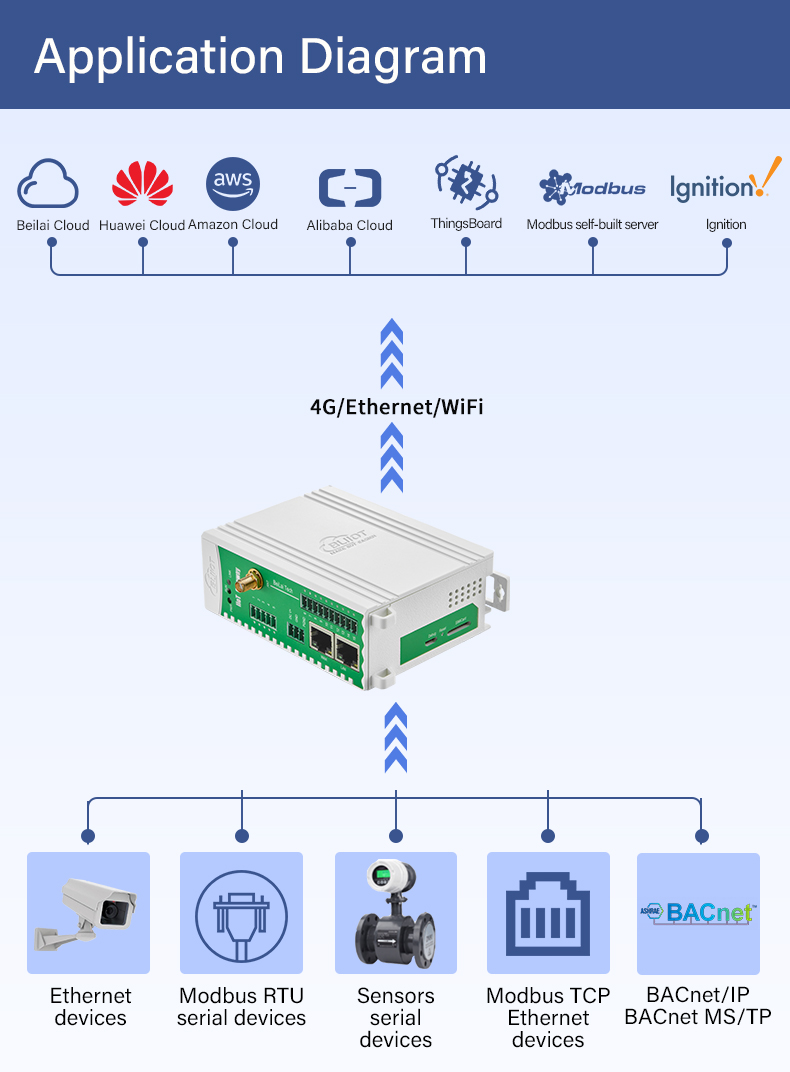
The BACnet to MQTT gateway sits between the field control layer and the cloud platform layer:
- HVAC devices connect via BACnet/IP or MS/TP.
- The gateway acts as a BACnet Client to read data points, performing local parsing, mapping, and caching.
- Data is converted to MQTT messages and uploaded to cloud platforms or private servers.
Advantages:
- No disruption to existing control logic.
- Independence from legacy BMS vendors.
- Flexible integration with various platforms.
Core Functions
-
Multi-Protocol Access Supports BACnet/IP (Ethernet) and MS/TP (RS485), simultaneous connection to multiple devices, with auto-discovery and manual point configuration.
-
Cloud Platform Integration Seamless docking with public cloud IoT platforms, BMS, Energy Management Systems (EMS), and digital twin/AI analytics platforms.
-
Edge Computing and Reliability Local caching (no data loss during outages), multi-network support (Ethernet/4G/WiFi), industrial-grade design for 7×24 operation.
Typical Application Scenarios
- Smart Building Centralized Management: Unified cloud upload of multi-building data, breaking information silos.
- Energy Management and Optimization: Real-time collection of temperature, valves, and status for load analysis and savings (potential 10-15% reduction in HVAC energy).
- Predictive Maintenance: Real-time anomaly alerts via MQTT, cloud-based health analysis to reduce downtime.
- Green Building and Carbon Management: Direct use of energy data for carbon accounting, meeting ESG requirements.
Key Selection Criteria
- Dual support for BACnet/IP and MS/TP.
- Point capacity and acquisition performance.
- Flexible MQTT Topics and data formats.
- Remote configuration and upgrades.
- Industrial-grade reliability (redundancy, security).
Conclusion
The BACnet to MQTT gateway is more than a simple protocol converter—it is essential infrastructure driving HVAC systems toward cloud enablement, intelligence, energy optimization, and AI-driven control. It makes traditional system data truly "flow," laying a solid foundation for smart buildings and digital energy management.


