ARM photovoltaic controllers provide a complete solution for monitoring photovoltaic circuit breakers, characterized by high reliability, low power consumption, and intelligence, driving the development of photovoltaic systems towards intelligent and predictive maintenance.
Case Details
In photovoltaic (PV) power generation systems, DC/AC circuit breakers are critical equipment for ensuring safe system operation, primarily responsible for overload protection, short-circuit protection, and fault isolation. As PV power stations continue to grow in scale and the demand for unattended operation increases, higher requirements have been placed on real-time monitoring of circuit breaker operating status, remote alarms, and predictive maintenance.
ARM photovoltaic controllers, with their low power consumption, high integration, and rich communication capabilities, are becoming the core control units for intelligent monitoring of PV circuit breakers. They enable efficient edge-side data processing, facilitating the transition from traditional "passive protection" to "active perception and predictive maintenance," thereby improving overall system reliability and operational efficiency.
System Architecture Overview
ARM photovoltaic controllers are typically deployed in combiner boxes, on the inverter side, or in distribution cabinets, serving as edge monitoring and control nodes. The system adopts a layered architecture design:
- Front-End Sensing Layer
- Voltage/current sensors (DC/AC)
- Circuit breaker open/close status detection
- Contact temperature monitoring (NTC, PT100, or infrared)
- Mechanical life and operation count statistics
- Edge Control Layer (ARM Controller Core)
- Real-time data acquisition and filtering
- Status judgment and anomaly detection
- Local linkage control (tripping, interlocking)
- Data caching and edge computing
- Communication and Platform Layer
- Supports multiple interfaces such as RS485, CAN, Ethernet, 4G/5G
- Compatible with protocols like Modbus, IEC 104, MQTT (BLIoTLink IoT Gateway)
- Integration with SCADA, EMS, or cloud platforms for remote management
Core Functions
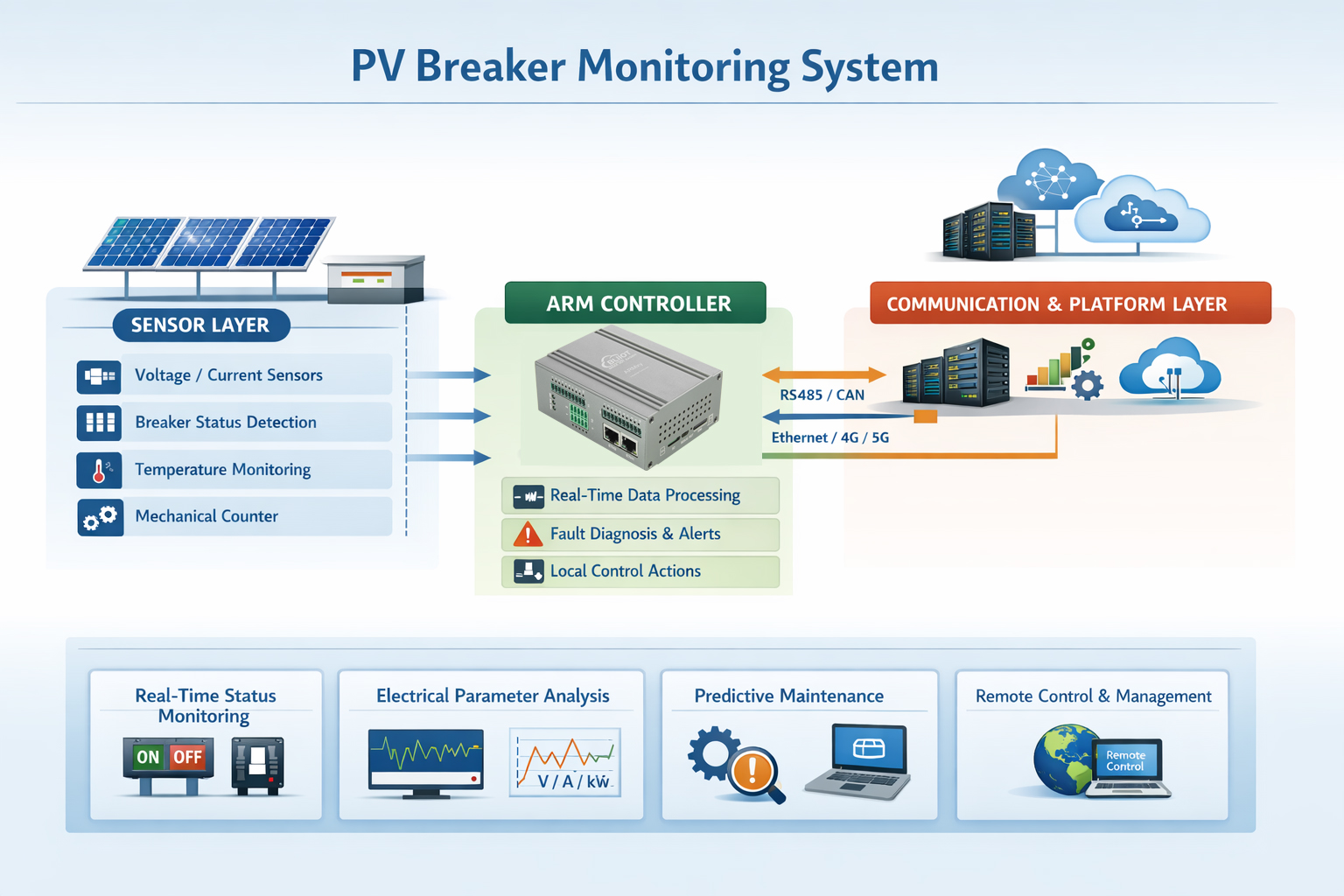
- Real-Time Monitoring of Circuit Breaker Status Supports millisecond-level perception, including open/close status, refusal to operate/maloperation detection, abnormal operation time, and contact temperature rise exceeding limits, preventing fault escalation.
- Electrical Parameter Acquisition and Analysis Collects DC-side voltage/current, AC-side three-phase voltage/current, power, power factor, and harmonics. Combined with circuit breaker status, it identifies issues such as overload operation, short-circuit risks, or poor contact.
- Edge Intelligence and Fault Early Warning Runs rule engines or lightweight algorithms locally for temperature rise trend analysis, operation count-based life assessment, and anomaly pattern recognition, enabling pre-fault warnings and predictive maintenance.
- Remote Monitoring and Centralized Management Via Ethernet or cellular networks, achieves real-time data upload, authorized remote open/close control, and unified management of multiple arrays or stations, significantly reducing O&M costs.
Advantages of ARM Architecture
| Advantage |
Description |
Applicability Notes |
| Low Power Consumption |
Suitable for outdoor PV applications, extending system endurance |
Preferred for unattended stations |
| High Stability |
Industrial-grade SoC, supporting 7×24 continuous operation |
Reliable in harsh environments |
| Rich Interfaces |
Strong expandability with GPIO, ADC, RS485, CAN, etc. |
Easy integration of various sensors and devices |
| System Support |
Linux/RTOS, facilitating secondary development and extensions |
Supports deployment of edge AI algorithms |
| High Cost-Effectiveness |
Lower cost and sufficient performance compared to x86 architecture |
Significant economic advantage for large-scale deployment |
Typical Application Scenarios
- Status monitoring of circuit breakers in PV combiner boxes
- Intelligent upgrade of AC-side circuit breakers in inverters
- Remote management of distribution cabinets in distributed PV systems
- O&M optimization for commercial and industrial rooftop PV
- Unattended upgrades for centralized power stations
Summary
ARM photovoltaic controllers provide a highly reliable, low-power, and intelligent complete solution for monitoring PV circuit breakers. They not only achieve real-time status perception and electrical parameter analysis but also support edge intelligent warnings and remote centralized management, driving PV systems toward intelligent and predictive maintenance directions, making them an important component of the new generation of intelligent PV power stations.


