This article explains how to use the BL190's RS485 port to collect soil pH, temperature/humidity, and CO₂ sensor data, employ DI/AI/relay modules for edge logic control of fans, roller shutters, and irrigation, and forward data upstream via Modbus TCP to SCADA or cloud platforms – enabling data-driven precision management for strawberry greenhouses.
Case Details
Walk into a typical strawberry greenhouse. You see neat rows, green leaves, and red fruit. But you cannot see if the temperature has exceeded 28°C, if CO₂ is too low, or if soil pH has drifted out of the preferred slightly acidic range.
For too long, greenhouse management has relied on manual inspection and paper records. Sensors, fans, and roller shutters work in isolation – creating data silos that hurt both the grower and the crop.
How to break these silos and achieve truly automated, precise cultivation? The answer is simpler than you think: one BL190 edge I/O module.
1. What Needs to Be Monitored?
Strawberries have specific environmental requirements at different growth stages:
|
Parameter
|
Optimal Range
|
Impact of Deviation
|
|
Air temp (flowering)
|
22–25°C
|
High temp reduces pollination; low temp causes poor fruit set
|
|
Air temp (fruiting)
|
20–25°C
|
Fluctuations affect fruit size and sugar content
|
|
Air humidity
|
50–60%
|
High humidity encourages gray mold and powdery mildew
|
|
Soil pH
|
5.5–6.5
|
pH deviation impairs nutrient uptake
|
|
CO₂ concentration
|
400–1200 ppm
|
Low CO₂ limits photosynthesis and reduces sugar
|
Required sensors: air temp/humidity, CO₂, light, soil pH, soil temp/humidity.
Actuators needing control: fans (ventilation/cooling), roller shutters (insulation/shading), drip irrigation valves, grow lights.
The challenge: sensors use 4-20mA, 0-10V, RS485, or discrete signals; actuators require relays, PWM, or analog outputs. How to integrate everything into one system?
2. BL190: One Module for Acquisition, Control, and Protocol Conversion
The BL190 is a Modbus TCP edge I/O module from BLIIOT IOy series. It replaces the traditional “PLC + I/O expansion + protocol gateway” combination.
Flexible Expansion – 1 to 3 Y Series I/O Boards
Users can freely combine boards:
- Y31 (4AI)– 4-20mA / 0-10V for temp/humidity, CO₂, light sensors.
- Y11/Y12/Y13 (8DI)– status feedback from valves, limit switches.
- Y21/Y22 (8DO)– indicator lights, alarms.
- Y24 (4 relay)– fans, roller shutters, pumps (high power).
- Y41/Y43 (4AO)– variable-frequency fans, proportional valves.
- Y95/Y96 (PWM + counter)– LED grow light dimming, pulse flow meters.
- Y51/Y52 (2 RTD)– PT100/PT1000 for high-precision soil/air temperature.
- Y58 (4 TC)– thermocouple inputs.
Example configuration for a medium greenhouse: Y31 (analog sensors) + Y52 (PT1000 soil temp) + Y24 (relay control) + Y95 (PWM dimming) – fully sufficient.
RS485 + Modbus RTU – Collecting Distributed Sensor Data
Many smart sensors (e.g., RS485 soil pH, multi-parameter weather sensors) output Modbus RTU, not analog signals. The BL190 provides an isolated RS485 port acting as a Modbus RTU master.
How to set up:
- Go to “Modbus” → “Modbus Settings” on the web page.
- Create a master task: slave address, function code, start register, quantity.
- The BL190 polls automatically and maps data to internal registers.
- Now all data – analog or RS485 – lives in one unified space.
Modbus TCP + Dual Ethernet Ports – Upstream to Any SCADA/Cloud
The BL190 runs a standard Modbus TCP server, exposing all DI/DO/AI/AO and collected data as Modbus registers. Any Modbus TCP client (PLC, HMI, SCADA, cloud) can read or write over Ethernet.
Two 10/100M ports with integrated switch:
- ETH 0– connects to the upper network (SCADA/PLC/cloud).
- ETH 1– cascades additional BL190 or IOy nodes without an external switch.
Bypass mode keeps the link alive even if the module fails – critical for multi-greenhouse setups.
Built-in Logic Control – Automation That Really Works
Many “solutions” only offer remote display – the grower still manually taps a button. That is not automation.
The BL190 provides edge logic control configured via web pages, executed locally.
Examples :
- Rule 1 (temp > 28°C):AI1 (temp sensor, address 3000) > 28.0 → DO1 (fan relay, address 1000) = closed.
- Rule 2 (humidity > 70%):AI2 > 70.0 → DO2 (ventilation fan) = closed.
- Rule 3 (pH out of range):RS485 pH value < 5.5 or > 6.5 → DO3 (alarm) = on.
- Combined rule (shutter closed AND light low):DI1 = open AND AI3 < 2000 Lux → Y95 PWM output dims grow light.
These rules run locally and independently – even if the SCADA or network fails, control continues. That is real edge computing.
3. Complete System Architecture
- Field layer:4-20mA/0-10V sensors → AI module; RS485 smart sensors → RS485 port (Modbus RTU master); discrete signals → DI module.
- Control layer:Fans, shutters, valves → relay module (Y24); LED grow lights → PWM module (Y95).
- Network layer:ETH 0 → Modbus TCP to SCADA/PLC/cloud; ETH 1 → cascading.
- Platform layer:SCADA reads data and sends batch commands; cloud uploads via Modbus TCP or MQTT.
4. Five Key Advantages of BL190
- All-in-one– Replaces PLC + I/O + gateway, reducing hardware cost by ~80%.
- Industrial reliability– -40°C to 85°C, ESD/EFT/Surge Level 3, perfect for harsh greenhouse environments.
- Flexible scaling– One module supports 1-3 I/O boards; multiple modules cascade via ETH 1. Works for one greenhouse or dozens.
- Remote maintenance– BLRAT tool allows firmware upgrades and parameter changes over the internet, cutting travel costs.
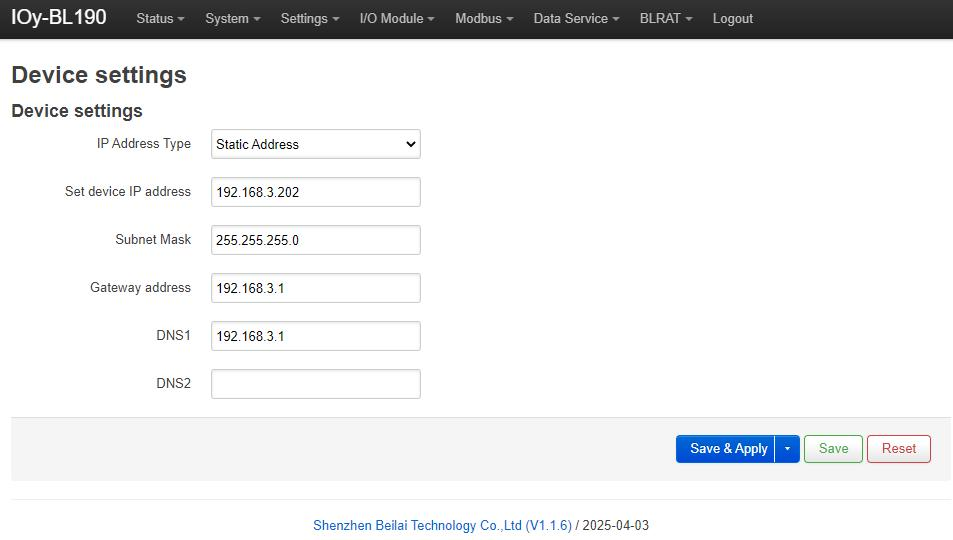
- Web configuration, no coding– All settings through a browser (default IP 192.168.3.2). Electricians can learn in minutes.
5. Value: From Experience-Based to Data-Driven
After deployment:
- No more manual rounds with thermometers and pH testers – all data on the SCADA screen.
- Temperature >28°C → fan starts in seconds.
- CO₂ too low → ventilation adjusts automatically.
- pH out of range → alarm and log.
- All data saved for agronomic analysis.
According to protected fruit cultivation guidelines, night temperature should not fall below 5°C and humidity should be 50–60%. With BL190, these standards become automatically enforced production rules – not just paper requirements.
Conclusion
Breaking data silos in a strawberry greenhouse means connecting temperature sensors to fans, pH sensors to alarms, and the RS485 bus to Modbus TCP. That is exactly what the BL190 does best.
Whether you are planning a new strawberry farm or upgrading an existing one, the BL190 provides a low-cost, highly reliable, and easy-to-deploy solution. For questions or configuration support, contact Beilai technology – from consulting to after-sales, we support your smart agriculture journey.


