New Paradigm for Chemical Process Control: BLIIoT’s EdgePLC Integrates APC2.0 Concept and IEC 61499 Standard to Achieve CODESYS Logic Control and AI Vision Safety Monitoring
Case Details
New Paradigm for Chemical Process Control: BLIIoT’s EdgePLC Integrates APC2.0 Concept and IEC 61499 Standard to Achieve CODESYS Logic Control and AI Vision Safety Monitoring
I. Industry Pain Points in Chemical Process Control
In chemical production, tasks such as reactor temperature/pressure control, valve actuation, and material batching require millisecond-level real-time responses. At the same time, AI vision systems are needed for personnel safety monitoring, leak detection, equipment status identification, etc. Traditional solutions use a PLC for logic control and a separate industrial PC or server for vision analytics. The two systems run independently, leading to data silos, slow response, and difficult maintenance.
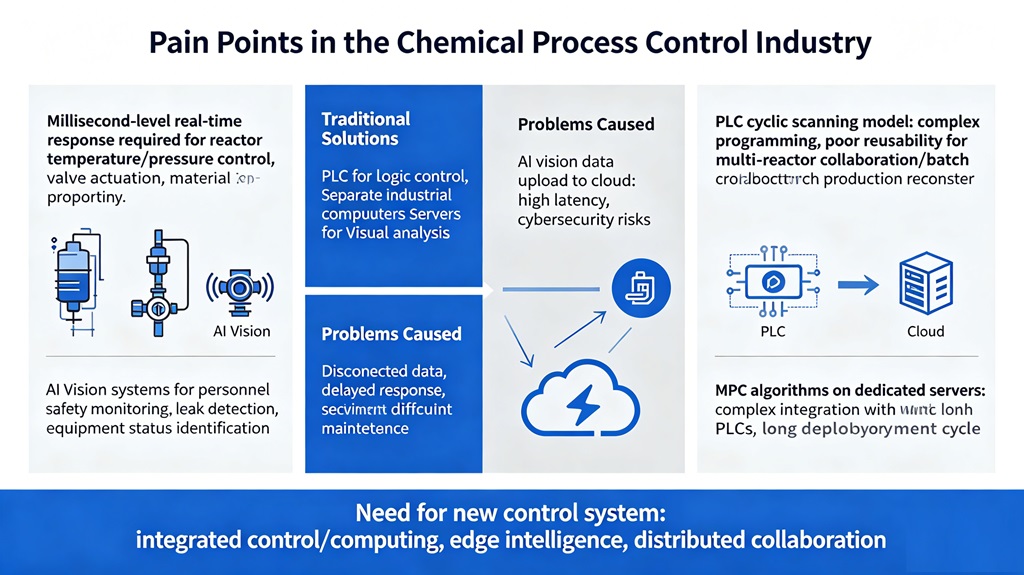
Moreover, traditional PLCs are based on a cyclic scan model, which makes them complex and non‑reusable when dealing with multi‑reactor coordination or flexible batch production. Advanced AI vision data often have to be sent to the cloud for processing, resulting in high latency and network security risks. Meanwhile, advanced process control algorithms (e.g., model predictive control – MPC) typically run on dedicated servers and require complex integration with the underlying PLC, leading to long deployment cycles.
These pain points drive chemical enterprises to seek a new control system that is control‑compute integrated, edge‑intelligent, and distributedly collaborative.
II. APC2.0 Concept: The Direction of Advanced Process Control
APC2.0 (Advanced Process Control 2.0) is an industry concept in the process control domain, not a mandatory standard. Building on traditional APC (e.g., PID, MPC), it emphasises the integration of edge real‑time computing, AI inference, open connectivity, and distributed intelligence into process control, moving control systems from “centralised, single‑loop regulation” towards “edge intelligence and collaborative optimisation”. In short, APC2.0 represents the cutting‑edge thinking of process control in the Industry 4.0 era: making control smarter, more local, and more collaborative.
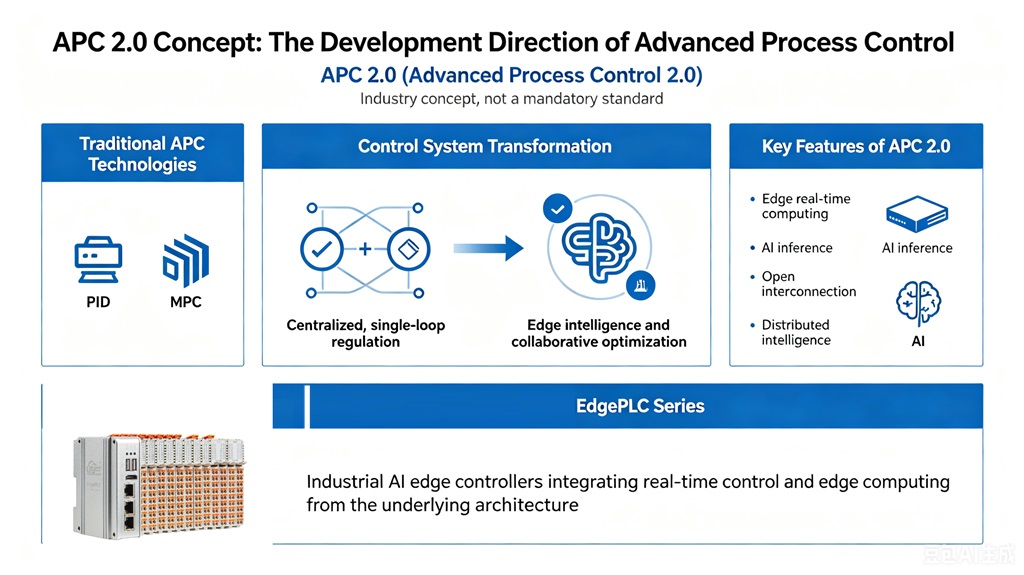
The EdgePLC series of industrial AI edge controllers launched by BLIIoT (Shenzhen Bili Technology Co., Ltd.) is designed precisely based on the APC2.0 concept. It is not a simple combination of a PLC and an industrial PC, but rather a product that fuses real‑time control and edge computing capabilities from the ground up.
III. EdgePLC: BLIIoT’s Industrial AI Edge Controller Product
EdgePLC is the product series name of the industrial AI edge controller independently developed by Shenzhen Bili Technology Co., Ltd. (BLIIoT), standing for “edge programmable logic controller”. Unlike a traditional PLC, EdgePLC retains high real‑time control capability while integrating a 1 TOPS NPU, running a Linux + Ubuntu 20.04 operating system, supporting Docker containers and Python/C++ secondary development, and embedding both a CODESYS Runtime and an IEC 61499 runtime environment. It is a true “control‑compute integrated” industrial control product.
IV. Integration of Two Control Standards: CODESYS (IEC 61131‑3) and IEC 61499
1. CODESYS: The de facto standard for traditional PLC programming
CODESYS is a globally widely used industrial control programming platform that fully complies with the IEC 61131‑3 standard (supporting the five languages: LD, FBD, ST, IL, SFC). The CODESYS Runtime can run on various hardware platforms, providing high real‑time logic control, motion control, etc. For engineers accustomed to traditional PLC programming, CODESYS has almost no learning curve.
EdgePLC embeds the CODESYS Runtime, allowing users to directly use the CODESYS development environment to write chemical process control logic, such as:
2. IEC 61499: The standard for distributed event‑driven control
IEC 61499 is an international standard for distributed industrial control systems published by the IEC. Unlike the cyclic scan model of IEC 61131‑3, IEC 61499 adopts an event‑driven, function block network architecture. This means:
-
Control logic is triggered by “events” rather than fixed‑cycle scans, offering faster response.
-
Function blocks can be distributed across multiple controllers, supporting hot swap, online modification, and cross‑device coordination.
-
It is particularly suitable for multi‑unit coordination, batch production reconfiguration, and safety interlock broadcasting in the chemical industry.
EdgePLC supports an IEC 61499 runtime environment. Multiple EdgePLC units can form a logical “large controller” through a function block network, achieving cross‑device collaborative control.
V. Concrete Application: CODESYS Logic Control + IEC 61499 Distributed Coordination + AI Vision Safety Monitoring
Take a multi‑reactor interlock control and plant‑wide personnel safety monitoring system as an example to illustrate how EdgePLC is deployed in chemical process control.
1. Single‑reactor real‑time control (based on CODESYS)
Each EdgePLC executes IEC 61131‑3 logic programs through its CODESYS Runtime to independently control one reactor:
-
Connect to N‑series distributed I/O modules (temperature, pressure, valves, agitator motor) via EtherCAT.
-
Acquire data in milliseconds, run PID algorithms to adjust heating power and cooling water flow.
-
Achieve local closed‑loop control without relying on a host computer.
2. Multi‑reactor coordination (based on IEC 61499)
Connect multiple EdgePLC controllers via industrial Ethernet and deploy an IEC 61499 function block network:
-
Sequential start: A “StartSeq” function block triggers start events of each reactor in order.
-
Material proportioning coordination: The discharge event of an upstream reactor triggers the opening of the downstream feed valve.
-
Emergency stop broadcast: When any EdgePLC detects an abnormality (e.g., overpressure), it notifies all associated controllers within 50 ms through the event network to execute safety logic.
3. AI vision safety monitoring (built‑in NPU + YOLOv5)
EdgePLC incorporates a 1 TOPS NPU that can directly run the YOLOv5 object detection model to analyse camera feeds locally:
-
Identify personnel illegally entering hazardous areas
-
Detect missing safety helmets or protective clothing
-
Identify equipment leakage, smoke, or other anomalies
Inference latency is below 50 ms. The detection results can be converted into IEC 61499 events to trigger local audible/visual alarms or interlock shutdowns.
4. Control‑vision closed‑loop coordination
When AI vision detects a person illegally entering a reactor area, the vision function block of the EdgePLC generates a “SafetyViolation” event, which is broadcast to all associated controllers via the IEC 61499 event network. Each EdgePLC immediately executes its own safety logic: stop agitation, close feed valves, activate alarm lights. The whole process is completed at the edge without cloud involvement, and the cross‑controller response time is less than 100 ms.
5. Remote operation & data visualisation
EdgePLC comes with BLIIoT’s BLRAT remote operation and maintenance tool and Node‑RED visual orchestration tool. Engineers can:
-
Remotely view CODESYS program running status
-
Modify IEC 61499 function block parameters online
-
Retrieve AI alarm history
-
Report data to the plant MES or SCADA system via MQTT/OPC UA
VI. Core Value EdgePLC Brings to Chemical Enterprises
VII. Conclusion
The EdgePLC industrial AI edge controller strictly follows the APC2.0 industry concept (advanced process control evolving towards edge intelligence, AI integration, and distributed collaboration), deeply integrates the IEC 61499 distributed event‑driven standard with the CODESYS (IEC 61131‑3) real‑time logic control, and embeds an NPU for AI vision safety monitoring. It provides a high real‑time, highly intelligent, highly reliable, distributedly collaborative all‑in‑one solution for chemical process control – a successful practice of evolving from traditional PLC to “control‑compute integration”.
Guided by the APC 2.0 concept, BLIIoT will continue to drive industrial controllers towards openness, intelligence, and collaboration, helping chemical enterprises build safe, efficient, and flexible next‑generation smart factories.


