This solution utilizes the ARMxy BL370 Series AI Edge Gateway from Shenzhen Beilai Technology Co., Ltd. as the "intelligent edge brain" for wind turbines. Deployed inside the turbine tower, close to various sensors and actuators, it enables comprehensive perception of the turbine's operational status, real-time intelligent analysis, local automatic control, and efficient data transmission to the cloud. It provides robust data and computing support for condition monitoring, predictive maintenance
Case Details
AI Edge Gateway ARMxy BL370 Application Solution for Wind Turbines
I. Solution Overview
Wind turbines are typically located in remote and harsh environments, such as open fields or offshore sites, where stable operation is crucial for ensuring power generation efficiency. Traditional monitoring systems face challenges such as limited types of data acquisition, high bandwidth costs for network transmission, significant delays in cloud analysis, and an inability to achieve real-time edge intelligence and decision-making.
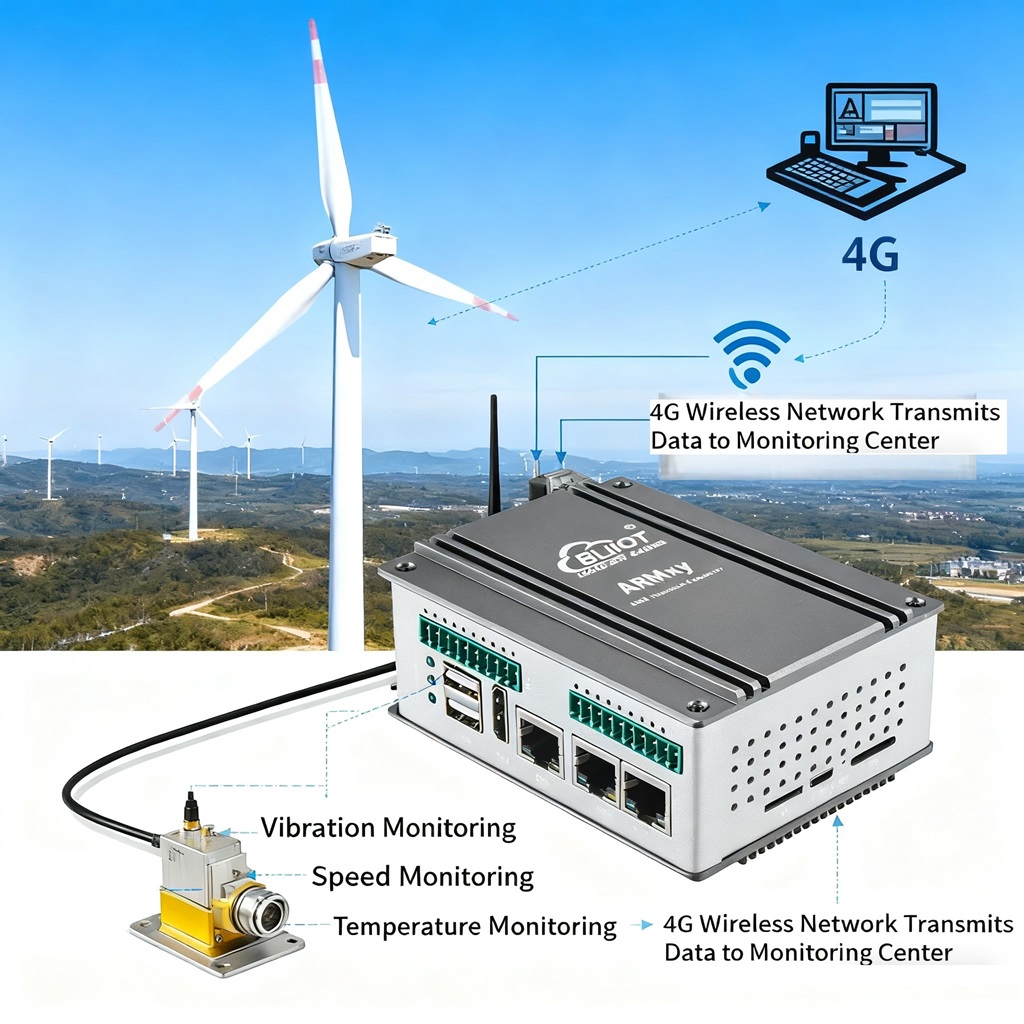
This solution utilizes the ARMxy BL370 Series AI Edge Gateway from Shenzhen Beilai Technology Co., Ltd. as the "intelligent edge brain" for wind turbines. Deployed inside the turbine tower, close to various sensors and actuators, it enables comprehensive perception of the turbine's operational status, real-time intelligent analysis, local automatic control, and efficient data transmission to the cloud. It provides robust data and computing support for condition monitoring, predictive maintenance, and intelligent operation of wind turbines.
II. Core Challenges of Wind Turbines and How the BL370 Addresses Them
III. System Architecture and Workflow
-
Data Acquisition Layer:
-
The BL370 gateway connects to vibration accelerometers, temperature sensors (PT100/thermocouples), pressure sensors, encoders, frequency converters, PLCs, etc., on the turbine through its rich I/O boards.
-
Edge Processing Layer (ARMxy BL370 Core):
-
Data Aggregation & Protocol Conversion: Built-in BLIoTLink software converts data acquired from different protocols (Modbus, CANopen, etc.) into standard protocols like MQTT, OPC UA.
-
Real-Time Analysis & AI Inference: Utilizes NPU computing power for real-time edge AI analysis of vibration data, executing fault diagnosis algorithms. Performs logical judgment on temperature, pressure, and other data to trigger out-of-limit alarms.
-
Local Control & Linkage: Can execute simple local control based on preset logic, such as triggering alarm signals, controlling the start/stop of cooling systems, etc.
-
Cloud Platform & Application Layer:
-
The BL370 transmits processed result data securely to cloud SCADA systems, IoT platforms (e.g., AWS IoT, Alibaba Cloud), or big data analysis platforms via 4G/5G (expanded via Mini PCIe) or Ethernet.
-
The cloud platform performs big data analysis, historical trend display, generates health reports, and provides visual interfaces and mobile alarm information for maintenance personnel, guiding maintenance plans.
IV. ARMxy BL370 Selection Recommendations
For wind power generation applications, the following configuration is recommended:
-
Main Unit Model: BL371B (2 Ethernet ports, 1x 20PIN X board slot, 2x Y board slots), facilitating connection to more I/O devices and networks.
-
SOM Core Board: SOM371 (RK3562J, 1.8GHz, 16G eMMC + 2G RAM) or SOM374 (RK3562, 2.0GHz, 16G eMMC + 2G RAM), providing sufficient computing power and storage space to run the operating system and AI algorithms.
-
X-Series I/O Board: Depending on the number of communication interfaces required, choose X24 (3x RS232/485, 1x CAN, 4x DI, 4x DO) or X25 (2x RS232/485, 2x CAN, 4x DI, 4x DO) for connecting control units and digital signals.
-
Y-Series I/O Boards:
-
Y52: 2-channel PT1000 temperature measurement for high-temperature monitoring of critical parts.
-
Y58: 4-channel thermocouple measurement for multi-point temperature monitoring.
-
Y36: 4-channel differential input (±10V) AI module for high-precision vibration sensor signal acquisition.
-
Y95/Y96: For speed pulse counting.
-
Communication Module: Built-in 4G/5G module (expanded via Mini PCIe) ensures reliable data transmission in wind farms without wired network deployment.
V. Solution Value
-
Improve Reliability: 24/7 uninterrupted condition monitoring and early fault预警, shifting from "reactive maintenance" to "predictive maintenance," avoiding catastrophic failures.
-
Reduce Maintenance Costs: Reduce unplanned downtime, optimize maintenance schedules, and significantly save on manual inspection costs and unnecessary part replacements.
-
Optimize Power Generation Efficiency: Continuous analysis of operational data can identify performance degradation trends and enable optimization adjustments to increase power generation.
-
Data-Driven Decision Making: Provides comprehensive, accurate, and real-time big data support for wind farm operation and management, enabling intelligent decision-making.
VI. Conclusion
The ARMxy BL370 AI Edge Gateway, with its industrial-grade reliability, rich interface flexibility, and powerful edge AI computing power, perfectly meets the stringent requirements for intelligence and reliability in the wind power generation industry. It is an ideal edge computing core unit for building a new generation of intelligent wind turbine monitoring systems, achieving cost reduction, efficiency improvement, and digital transformation. The comprehensive support from hardware to software provided by Bliiot Technology further enables customers to rapidly develop and deploy customized intelligent wind turbine solutions.


