A heat pump may be the heart of the system—but smart peripheral control is what makes it truly efficient. Discover how EdgeIO, HVAC automation, and flexible I/O simplify heat pump integration.
Case Details
Opening: What is a Heat Pump?
Before we dive in, let's take two minutes to clarify one concept.
A heat pump does not "generate" heat—it "moves" heat.
Think of it as a "heat courier"—it extracts heat from outdoor air, groundwater, or soil and delivers it to your underfloor heating or radiators. Since it only pays the "delivery fee" (electricity) rather than producing the "package" (heat) itself, 1 kWh of electricity can move 3–5 kWh of heat. That's 3–5 times more efficient than electric heating.
Air-source heat pumps extract heat from the air (the most common type—think household air conditioners and air-to-water heaters). Water-source/ground-source heat pumps extract heat from groundwater or soil (suitable for large buildings). Regardless of the type, the system architecture follows the same logic.
Anatomy of a Heat Pump System
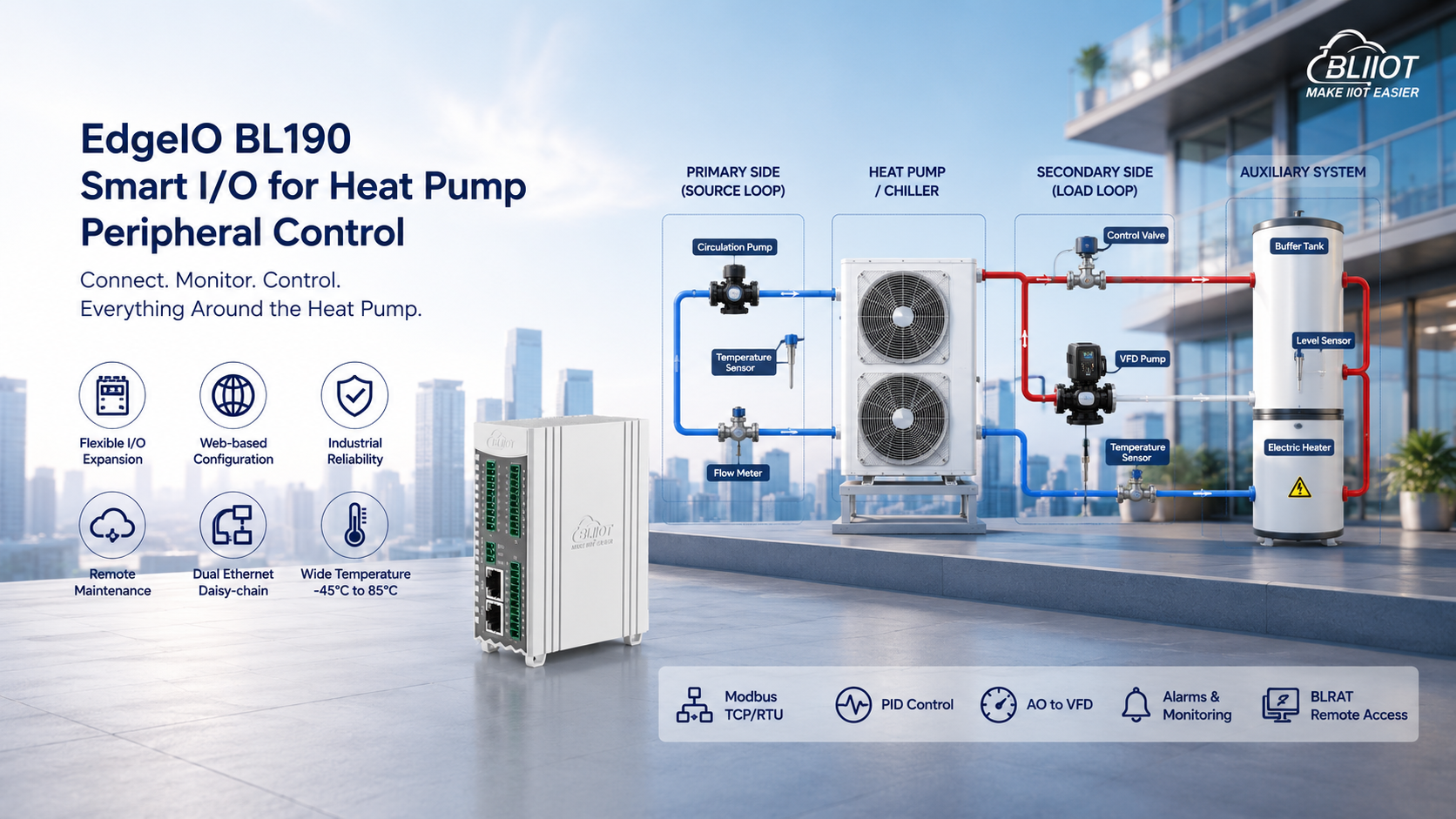
A complete heat pump system consists of four parts:
The chiller is the core—it contains the compressor, heat exchangers, and expansion valve. The chiller's built-in controller manages compressor start/stop, defrost, and protection logic. No one should touch this part.
The real work lies in the other three parts.
The primary side (source loop) is responsible for "borrowing" heat from the outside—whether through ground loops, wells, or cooling towers, circulation pumps move water to bring that heat back. You need to monitor whether the pump is running, what the water temperature is, and whether the flow rate is sufficient.
The secondary side (load loop) is responsible for "delivering" heat to the terminals—underfloor heating, fan coil units, or radiators. The key here is "comfortable delivery": stable water temperature and pressure, which requires control valves and variable-frequency pumps for precise regulation.
The auxiliary system serves two purposes: first, the buffer tank stores hot water to prevent the chiller from short-cycling (frequent starts waste energy and shorten equipment life); second, when it's too cold and the heat pump can't extract enough heat, the electric heater provides backup. You need to monitor the tank's water level, temperature, and the electric heater's output temperature.
So, What Does EdgeIO Do Here?
Looking at these four parts, the chiller is the manufacturer's domain. The pumps, valves, sensors, and electric heaters in the remaining three parts all need signal connectivity.
EdgeIO does exactly that—it connects the peripheral equipment to the system.
Specifically:
- Primary side: Control circulation pump start/stop, read pump running status and fault signals, collect inlet/outlet water temperature, pressure, and flow
- Secondary side: Control circulation pumps and control valves, read supply/return water temperature and pressure, send speed commands via AO to VFDs for differential temperature/pressure PID control
- Auxiliary system: Read tank temperature and level, receive low-level alarm signals, control electric heater switching
A typical configuration requires approximately: 3 DI, 3 DO, 9 AI, and 1 AO—exactly the range that EdgeIO BL190 can flexibly cover with its modular design.
Field Challenges That EdgeIO Solves
Anyone working in the field knows this: the biggest headaches in heat pump projects aren't the chiller—they're the peripherals.
Challenge 1: Too many devices stacked together. Traditional solutions use separate I/O modules, gateways, and controllers—crammed into the cabinet with complex wiring and plenty of failure points. EdgeIO consolidates all of this into a single device.
Challenge 2: Commissioning means endless site visits. Every project requires engineers to travel on-site to adjust parameters—days lost each time. EdgeIO configures through a web browser without installing any software. No need to haul a laptop into the machine room.
Challenge 3: Signals go haywire when the VFD kicks in. Heat pump sites are filled with large motors and VFDs creating massive interference. EdgeIO features industrial-grade EMC protection—ESD, EFT, and surge all at Level 3. The signal stays rock-solid.
Challenge 4: Every parameter change requires another site visit. When the client wants to adjust temperature setpoints or timing schedules later on, that means another trip. EdgeIO supports remote access—engineers can make changes from the office, and the travel costs saved often exceed the device cost itself.
Challenge 5: Wiring is time-consuming and expensive. Multiple devices require many cables running back to the switch. EdgeIO's dual Ethernet ports support daisy-chaining—a single cable runs through all devices.
One Sentence Summary
Don't touch the chiller's domain. Leave the peripherals to EdgeIO.
Fewer devices for integrators to manage, fewer site visits, less interference to fight. Control the right points, capture the right signals—and leave the rest alone.
EdgeIO BL190 Key Specifications at a Glance


