BL121AC helps modernize existing HVAC systems without replacing working equipment. It connects Modbus RTU/TCP air conditioning devices to OPC UA platforms, enabling centralized monitoring, data integration and remote maintenance—making HVAC digitalization simpler, more efficient and future-ready.
An air conditioning system doesn't have to be new to become part of a smart building.
The real challenge is often much simpler:
How do you connect existing air conditioning equipment to a modern OPC UA-based platform?
Imagine a commercial building with multiple air conditioning units.
The HVAC controllers are already installed and working reliably. Some devices communicate through Modbus RTU, while others use Modbus TCP.
Now the building owner wants to integrate them into a centralized SCADA, energy management system, or building automation platform based on OPC UA.
Replacing the existing HVAC controllers?
Too expensive.
Rebuilding the entire communication network?
Too disruptive.
Leaving the systems isolated?
Not an option.
This is where BL121AC comes in.
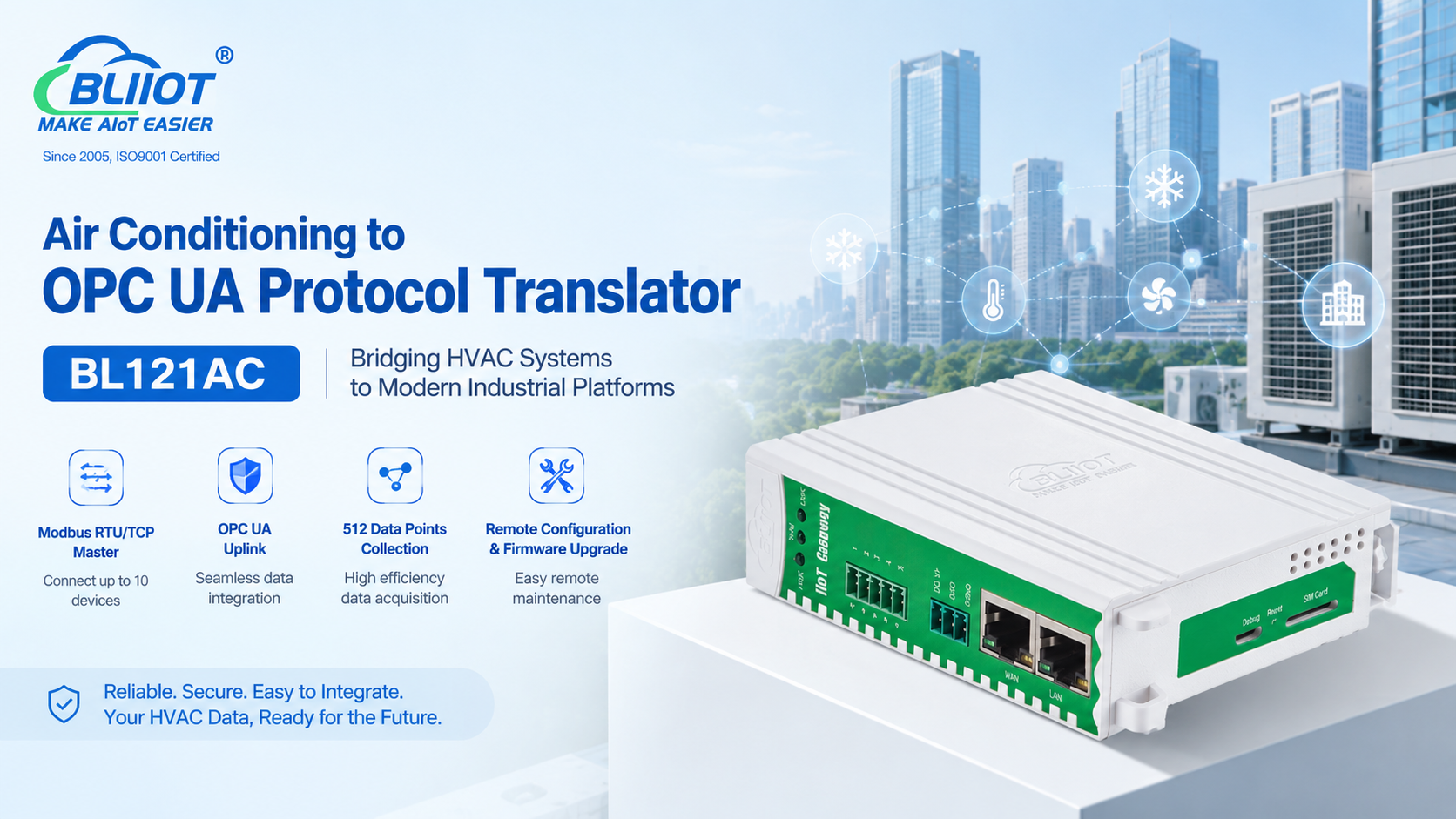
BL121AC is an Air Conditioning to OPC UA Protocol Translator designed to bridge existing air conditioning equipment with modern OPC UA platforms.
The architecture is straightforward:
Air Conditioning Equipment
↓
Modbus RTU / Modbus TCP
↓
BL121AC
↓
OPC UA
↓
SCADA / EMS / BMS Platform
Instead of replacing working HVAC equipment, the gateway creates a communication bridge between the existing field layer and the new digital platform.
BL121AC supports Modbus RTU Master and Modbus TCP Master on the device side, with OPC UA on the uplink side, and can collect data from up to 10 devices and 512 data points.
That means HVAC data such as operating status, temperatures, setpoints, alarms and other available Modbus data can become part of a centralized monitoring architecture—depending on the registers provided by the air-conditioning equipment.
Why does this matter for HVAC retrofit projects?
Because many buildings don't need a completely new control system.
They need a better way to use the data they already have.
With two RS485/RS232 interfaces and two Ethernet ports, BL121AC can connect different communication layers within an existing HVAC environment. It also supports remote configuration and remote firmware upgrades, making later maintenance easier.
For system integrators, this means a more practical approach to HVAC digitalization:
Keep the equipment. Keep the existing field network. Add the data connection. Move the HVAC system toward OPC UA.
That's the real value of protocol translation.
Not simply changing one protocol into another—
but giving existing air conditioning systems a path into the modern industrial data world.


