DDR4 and LPDDR4X are not a simple case of “which is better,” but rather two different technical paths tailored to different application scenarios:
DDR4 = Stability + Low Latency + Strong Control Capability
LPDDR4X = Low Power + High Bandwidth + High Integration
In today’s rapidly developing landscape of industrial automation and edge computing, memory is no longer just about capacity — it directly impacts system power consumption, performance, stability, and overall product design. Among various memory solutions, DDR4 and LPDDR4X have become the two most mainstream options for ARM-based embedded controllers.
So, what are the essential differences between these two memory types in real industrial applications? And how should you choose?
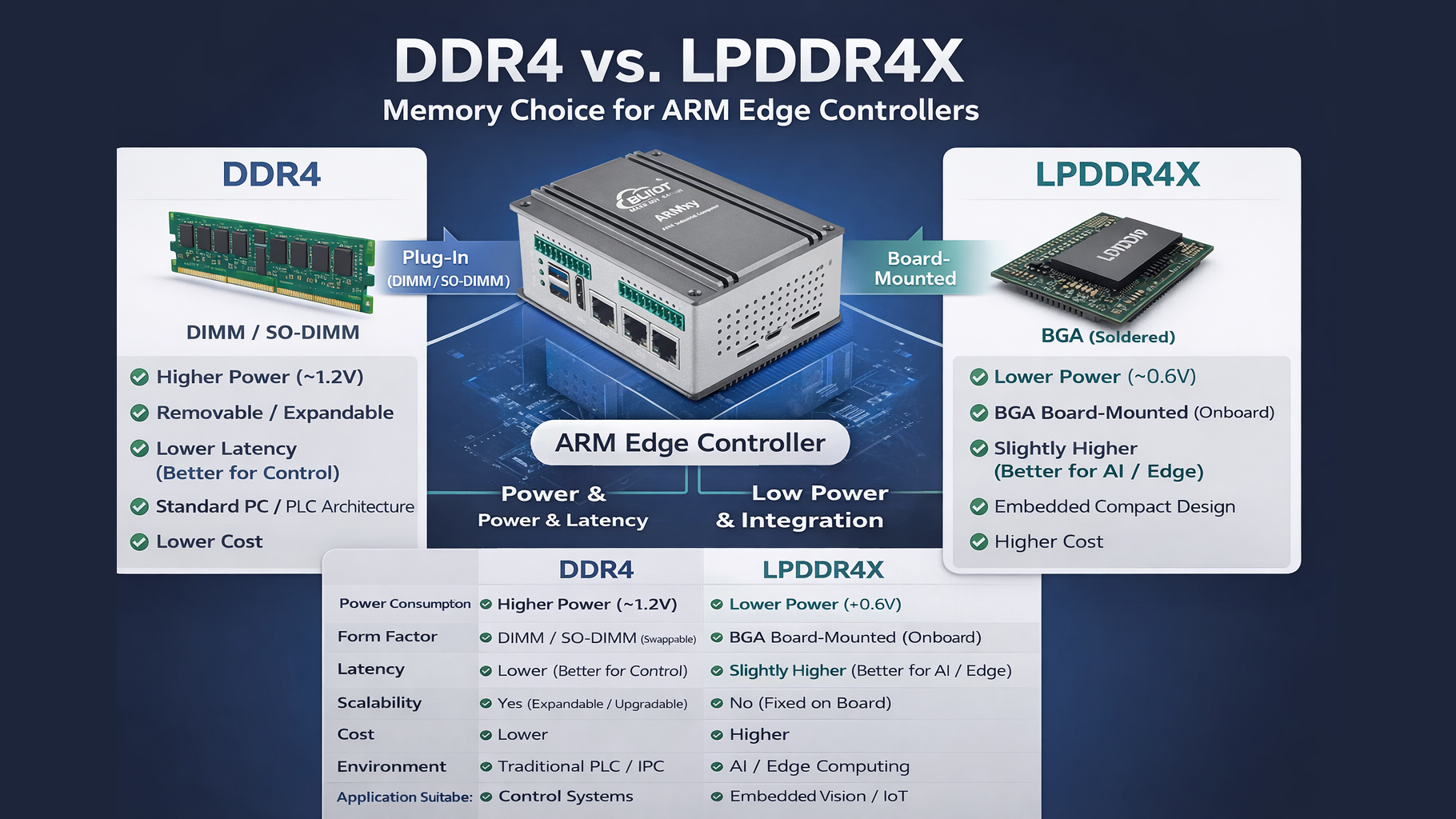
DDR4: The Stable Foundation of Traditional Industrial Control
DDR4 (Double Data Rate 4) is one of the most mature and widely adopted memory types in industrial computing devices. It is commonly found in:
- Industrial PCs (IPC)
- Traditional PLC systems
- High-reliability servers
- Some high-performance ARM controllers
Key Advantages
- Low Latency & Strong Real-Time Performance DDR4 offers lower access latency, making it ideal for applications with extremely high real-time requirements, such as:
- Motion control
- Production line automation
- Real-time data acquisition
- Excellent Scalability Supports DIMM/SO-DIMM slot designs, allowing flexible memory capacity upgrades and easy maintenance.
- Proven Maturity and Stability After years of industrial validation, it remains highly reliable even in high-temperature and heavy-load environments.
LPDDR4X: A Low-Power, High-Integration Solution for the Future
LPDDR4X (Low Power DDR4X) is an optimized low-power version based on DDR4 technology. Originally widely used in smartphones, it has now become a mainstream choice for edge computing and industrial AI devices.
Key Advantages
- Ultra-Low Power Consumption LPDDR4X reduces I/O voltage to approximately 0.6V, significantly lowering power consumption compared to DDR4:
- Better suited for 7×24 continuous operation
- Reduced device heat generation
- Extended product lifespan
- Higher Bandwidth Data rates can reach 4266 MT/s or even higher, making it ideal for:
- AI inference
- Video processing
- Multimedia computing
- High Integration (Onboard Design) Uses BGA packaging and is directly soldered onto the motherboard:
- Improved shock and vibration resistance
- Reduced risk of poor contact
- More suitable for compact industrial devices
DDR4 vs LPDDR4X: Core Differences
| Dimension |
DDR4 |
LPDDR4X |
| Power Consumption |
Higher |
⭐ Much Lower |
| Latency |
⭐ Lower |
Slightly Higher |
| Bandwidth |
High |
⭐ Higher |
| Packaging |
Socketed (DIMM) |
Onboard (BGA Soldered) |
| Maintainability |
⭐ Strong |
Weaker |
| Shock Resistance |
Average |
⭐ Better |
| Typical Applications |
Control-oriented |
AI / Edge Computing |
Practical Impact on ARM Edge Controllers
Impact on System Power Consumption In industrial field environments, devices typically require long-term stable operation:
- DDR4: Higher power consumption → more complex thermal design
- LPDDR4X: Significantly lower power → ideal for fanless designs
👉 For edge gateways and AI controllers, LPDDR4X has a clear advantage.
Impact on System Performance
- DDR4 → Better for real-time control logic
- LPDDR4X → Better for data-intensive tasks
Examples:
- PLC control systems → DDR4 is superior
- AI vision inspection → LPDDR4X performs better
Impact on Product Structure
- DDR4: Modular design, suitable for standard industrial computers
- LPDDR4X: Highly integrated, suitable for compact embedded devices
👉 More and more ARM platforms (such as RK3588 and RK3576) are now prioritizing LPDDR4X.
Typical Application Scenario Comparison
🔹 DDR4 is more suitable for:
- Industrial PLC and automation control systems
- Traditional Industrial PCs (IPC)
- Devices requiring on-site maintenance and upgrades
🔹 LPDDR4X is more suitable for:
- Industrial edge AI controllers
- Intelligent vision systems (AI cameras)
- IoT Gateways
- Fanless embedded devices
Future Trends: Moving from “Control” to “Intelligence”
With the integration of Industry 4.0 and AI, industrial devices are evolving from pure “execution and control” toward “data processing + intelligent decision-making”:
- Larger data volumes
- More complex algorithms
- Stricter power constraints
👉 Under this trend, LPDDR4X is becoming the mainstream choice.
However, it is worth noting that in core control loops with extremely high real-time requirements, DDR4 remains irreplaceable.
Conclusion
DDR4 and LPDDR4X are not a simple case of “which is better,” but rather two different technical paths tailored to different application scenarios:
- DDR4 = Stability + Low Latency + Strong Control Capability
- LPDDR4X = Low Power + High Bandwidth + High Integration
One-sentence summary: If the core of your system is industrial control, choose DDR4. If your system is oriented toward AI and edge computing, LPDDR4X is the better solution.


