A quiet yet profound transformation is underway in the field of industrial automation. The traditional PLC (Programmable Logic Controller), the "faithful executor" that has dominated production lines for decades, is now facing a more disruptive challenger: the AI Edge Controller. This is not merely a technological iteration but a paradigm shift from "automation" to "intelligence."
Farewell to the "Mechanical Arm," Embrace the "Intelligent Brain": How AI Edge Controllers Are Redefining the Rules of Industrial Automation?
A quiet yet profound transformation is underway in the field of industrial automation. The traditional PLC (Programmable Logic Controller), the "faithful executor" that has dominated production lines for decades, is now facing a more disruptive challenger: the AI Edge Controller. This is not merely a technological iteration but a paradigm shift from "automation" to "intelligence."
I. Core Positioning: An Essential Leap from "Executor" to "Decision-Maker"
-
Traditional PLC: A Specialist Focused on "Control"
Its core mission is deterministic logic control. Like a human spinal reflex, it receives sensor signals (e.g., switches, temperature), performs high-speed, reliable Boolean operations based on preset logic (ladder logic, instruction lists), and then drives actuators (e.g., motors, cylinders). Its advantage lies in ultimate reliability and microsecond-level response speed, making it suitable for scenarios with extremely high safety and real-time requirements, such as high-speed packaging machines and stamping equipment.
-
AI Edge Controller: A Generalist Integrating "Cloud-Edge-Device"
It is an industrial-grade supercomputer that integrates control, computing, communication, and AI capabilities. Its role is that of an "edge intelligence brain," responsible not only for control but also for understanding data, making intelligent decisions, and coordinating upstream and downstream. It can process unstructured data such as camera images, vibration waveforms, and audio signals, and make intelligent judgments on the spot.
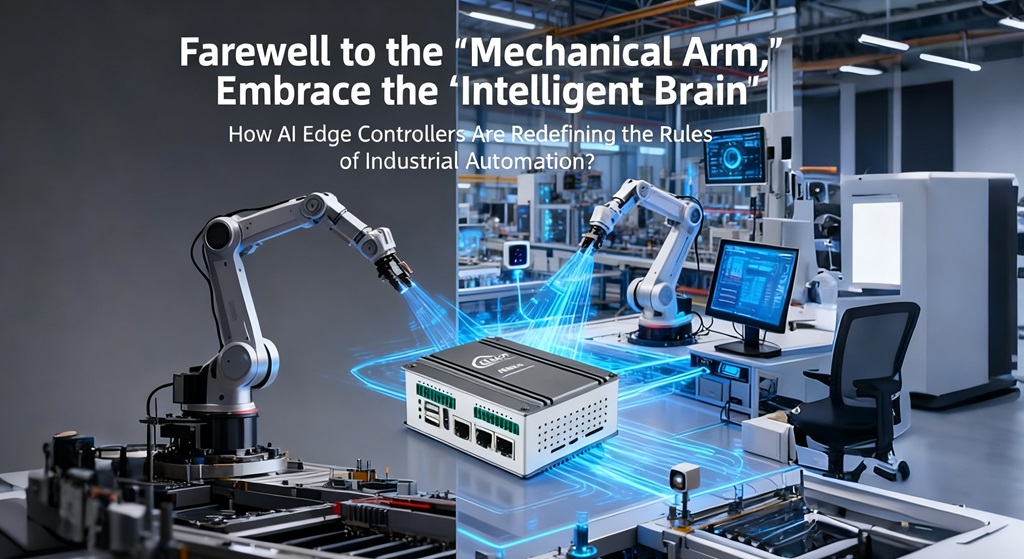
Metaphorically speaking: The PLC is the "peripheral nervous system" of the factory, responsible for reflex actions; while the AI Edge Controller is the "cerebellum" or even "cerebral cortex," responsible for perception, analysis, and issuing complex instructions.
II. Technical Architecture: Closed and Proprietary vs. Open and Integrated
This is the most fundamental difference between the two, determining their capability boundaries.
Conclusion: The PLC is a "feature phone" optimized for a specific task, while the AI Edge Controller is a "smart operating system" on which countless apps can be installed indefinitely.
III. Capability Comparison: Logic Control vs. Intelligent Insight
This architectural difference directly leads to a generational gap in capabilities.
-
Data Processing: From "Seeing" to "Understanding"
-
PLC: Can "see" a temperature value (50°C) and execute the command "if >45°C then stop."
-
AI Edge Controller: Not only can it see the temperature but also "understand" the spectrum of equipment vibration, predict through AI models that a bearing will fail within the next 72 hours, and proactively initiate a maintenance work order. It shifts from passive response to active prediction.
-
Task Scope: From "Single" to "Integrated"
-
PLC: Multiple PLCs may be needed on a production line to control feeding, processing, and inspection stages separately, communicating with each other through complex protocols.
-
AI Edge Controller: A single device can integrate control, visual inspection, data acquisition, protocol conversion (MQTT/OPC UA), edge alarming, and other tasks, greatly simplifying the system architecture.
-
System Maintenance: From "On-Site" to "Remote"
-
PLC: Program updates and fault diagnosis usually require engineers to be on-site, connecting a programming cable.
-
AI Edge Controller: Leveraging 4G/5G and remote maintenance tools (e.g., BL370's BLRAT), engineers can securely access devices anywhere in the world at any time, achieving "zero-distance" maintenance.
IV. Application Scenarios: Coexistence and Symbiosis, Not a Zero-Sum Game
It is important to recognize that AI Edge Controllers are not meant to completely replace PLCs but to empower and upgrade the entire automation system.
The best practice is often: The AI Edge Controller acts as the "brain" of the production line, performing intelligent analysis and decision-making; while the underlying PLCs act as the "spinal cord," continuing to execute the high-speed, reliable basic control tasks they excel at. The two collaborate via Ethernet or fieldbus, building a smarter and more efficient system together.
V. Summary: Why Is This Transformation "Disruptive"?
For enterprises, upgrading from PLCs to AI Edge Controllers means:
-
From "Capacity-Driven" to "Data-Driven": The factory's greatest asset is no longer the equipment itself but the data generated during its operation and the insights derived from it.
-
From "Preventive" Maintenance to "Predictive" Maintenance: Significantly reduce unplanned downtime, lower maintenance costs, and improve Overall Equipment Effectiveness (OEE).
-
Revolution in Maintenance Models: From "people going on-site" to "data traveling," enabling maintenance teams to be smaller, more efficient, and more global.
Therefore, this is not a simple technological upgrade but a strategic choice. When your competitors start equipping their production lines with "intelligent brains" to achieve cost reduction, efficiency gains, and unmanned operations, can you still be satisfied with only having "mechanical arms"?
The future is already here. Will you choose to remain a "follower" in the era of automation, or become a "definer" in the era of intelligence? The answer lies in your choice.


