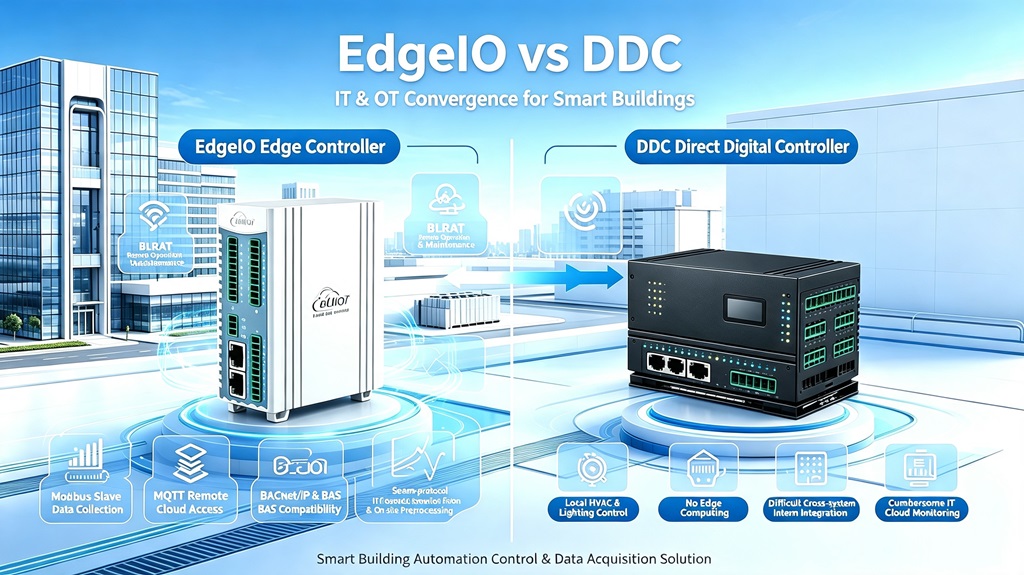
EdgeIO Edge Controller BA190Pro offers a completely new approach to this dilemma – one device replaces the cumbersome combination of “dedicated DDC + multi‑protocol gateway + cloud gateway”.
1. Background: New Challenges in HVAC Energy-Efficiency Control
Modern smart building HVAC systems face unprecedented complexity. On one hand, field devices are increasingly diverse – temperature sensors, CO₂ sensors, pressure transmitters, smart power meters, heat meters, etc. On the other hand, data flows are becoming multidirectional: building automation systems (BAS) require BACnet/IP, energy metering instruments mostly use Modbus RTU, central monitoring centers need MQTT for cloud upload, and IT data analysis platforms expect direct OPC UA access.
Traditional small DDC controllers were designed to address these very issues. However, with today’s deep convergence of IT and OT, HVAC energy control is no longer a simple “acquire–judge–output” closed loop; it demands cloud data upload, remote O&M, multi‑protocol integration, and IT/OT data interoperability. The limitations of traditional DDCs are becoming increasingly apparent.
EdgeIO Edge Controller BA190Pro offers a completely new approach to this dilemma – one device replaces the cumbersome combination of “dedicated DDC + multi‑protocol gateway + cloud gateway”, enabling seamless connectivity from field devices to BAS, cloud platforms, and IT systems.
2. Overview of BA190Pro and Small DDC
2.1 Traditional Small DDC: The “Veteran” of HVAC Control
A small DDC (Direct Digital Controller) is a common control device in building automation, typically used for temperature/humidity PID regulation, fan/pump start/stop, freeze protection, and similar tasks in medium‑ and small‑sized air‑conditioning systems. Its core working mode is: acquire sensor data via analogue signals (DC 0~10V or 4‑20mA), process through built‑in software, and then output signals to control valves or VFDs. One DDC usually manages an independent zone and is networked into the building’s central monitoring system.
2.2 BA190Pro: Multi‑Protocol Edge I/O Controller
The BA190Pro is a multi‑protocol edge I/O controller from Bari Technology, designed for smart buildings and HVAC systems. On top of BACnet/IP, it natively integrates Modbus TCP, OPC UA, and MQTT as three additional uplink protocols, delivering an all‑in‑one solution for building automation, cloud monitoring, and IT/OT data convergence. It supports wide‑range power input (typically 9~36 VDC), dual RJ45 Ethernet ports with an integrated switch, and an isolated RS485 port.
3. Core Functional Comparison
3.1 Protocol Support: Single/Dual‑Protocol vs. Four Native Protocols
Traditional DDCs typically support only one or two protocols. If you need to interface with both a BAS and a cloud platform, you often have to deploy multiple protocol‑conversion gateways. In contrast, the BA190Pro natively supports four mainstream protocols in a single device – no extra gateways are needed to interface with the local BMS or cloud platforms.
SEO Keywords: multi‑protocol edge controller, BACnet/IP controller, Modbus gateway replacement, OPC UA for buildings, MQTT cloud platform
3.2 Data Acquisition: Analogue‑Only vs. Multi‑Source Fusion
Traditional DDCs mainly acquire sensor data via analogue signals (0~10V or 4‑20mA). For Modbus RTU smart instruments (e.g., power meters, heat meters), an additional gateway is required.
The BA190Pro offers much richer data acquisition capabilities:
-
1 isolated RS485 port – acts as a Modbus RTU master, supporting up to 25 commands to directly collect data from smart meters, water meters, heat meters, and other instruments.
-
1~3 Y‑series I/O expansion slots – allow flexible combination of over 20 module types (digital, analogue, temperature, serial, pulse, etc.).
-
Dual RJ45 Ethernet ports – with an integrated switch, support daisy‑chain topology for simplified wiring.
SEO Keywords: Modbus RTU acquisition, smart instrument data collection, isolated RS485, Y‑series I/O expansion, temperature sensor acquisition
3.3 Local Configuration & HMI: Proprietary Software vs. Built‑in Web
Traditional DDCs or PLCs typically require installation of dedicated programming software – some need licenses, some are picky about OS versions, and firmware updates often require contacting support for files.
The BA190Pro provides a much more convenient local operation approach – a built‑in Web server that you open with a browser. On‑site engineers simply bring a laptop, connect an Ethernet cable to the module’s IP address, and all parameter settings and logic programming are done in web pages. No software pre‑installation is needed; no need to search for download links for configuration tools. Logic programming is entirely web‑based – you configure conditions, trigger relationships, and output actions in the web interface – no need to learn PLC ladder logic or ST language. The module executes these logic rules locally with millisecond‑level response times.
SEO Keywords: built‑in Web configuration, web‑based programming, no proprietary software required, browser configuration, codeless logic control
3.4 BAS System Integration: Gateway‑Dependent vs. Native BACnet/IP
When integrating a traditional DDC into a BACnet/IP BAS, if the device does not natively support BACnet/IP, an additional BACnet gateway is needed.
The BA190Pro is a native BACnet/IP EdgeIO controller specifically designed for building automation systems (BAS). Each I/O channel automatically generates corresponding BACnet objects (DI → Binary Input, DO → Binary Output, AI → Analog Input, AO → Analog Output). Data from Modbus RTU instruments can also be collected via the RS485 port and automatically mapped to BACnet objects. From the BMS perspective, all data appears as native BACnet data – no need to worry whether it comes from local I/O or serial instruments.
SEO Keywords: BACnet/IP BAS integration, building automation system integration, BACnet object mapping, seamless BMS connectivity
3.5 Remote O&M and Cloud Platform Access
Traditional DDC configuration often needs proprietary programming software, and remote O&M is even more difficult – firmware upgrades and parameter changes usually require engineers to travel on‑site.
The BA190Pro offers comprehensive remote O&M capabilities:
-
Built‑in Web configuration – browser‑based programming for register operations, conditional logic, PID tuning, etc.
-
Integrated BLRAT remote access tool – supports remote firmware upgrades, parameter changes, and diagnostics without on‑site presence.
-
MQTT direct to cloud – connects to mainstream cloud platforms (Alibaba Cloud, Huawei Cloud, etc.) as well as open‑source IoT platforms like ThingsBoard.
-
OPC UA open interface – provides standardised data access for upper‑level management software (MES, ERP, energy management platforms).
SEO Keywords: remote O&M, BLRAT remote tool, MQTT cloud access, ThingsBoard IoT platform, OPC UA IT/OT integration
3.6 Deployment & Expansion: Fixed Configuration vs. Modular Flexibility
Traditional DDCs usually come with fixed I/O configurations – when project requirements change, you may need to replace the entire unit or re‑wire.
The BA190Pro adopts a modular design with 1~3 Y‑series I/O expansion slots. Taking a typical HVAC project as an example: you need 8 DI for fan status, 4 AI for pressure transmitters, and 2 PT100 inputs for supply/return water temperature – just select Y11 (8DI) + Y31 (4AI) + Y51 (2‑channel PT100) . The three modules total only 40 mm in width and snap directly onto the DIN rail in the distribution cabinet. If later requirements change, you only replace one module – no need to replace the whole unit or re‑wire.
SEO Keywords: modular I/O expansion, Y‑series expansion modules, DIN‑rail mounting, flexible configuration
4. Comprehensive Comparison Summary
5. Conclusion: The IT Shift from DDC to EdgeIO
In modern smart‑building HVAC energy‑efficiency applications where IT and OT are deeply integrated, the BA190Pro edge controller demonstrates revolutionary advantages over traditional small DDCs:
First, extreme architectural simplicity. One BA190Pro replaces the complicated combination of “DDC + multi‑protocol gateways + cloud gateway”, significantly reducing hardware costs, minimising failure points, and shortening deployment time.
Second, comprehensive protocol support. It natively supports BACnet/IP, Modbus, OPC UA, and MQTT simultaneously – seamlessly connecting to the local BAS via BACnet/IP while also providing direct cloud access via MQTT/OPC UA.
Third, intelligent O&M. Built‑in Web configuration eliminates the need for proprietary software; the BLRAT tool enables remote firmware upgrades, parameter changes, and diagnostics, drastically lowering maintenance costs.
Fourth, flexible scalability. Modular I/O design with 1~3 expansion slots allows flexible configuration according to project needs, easily adapting to retrofits and capacity expansions.
For smart‑building HVAC energy systems that pursue efficiency, intelligence, and scalability, the BA190Pro represents the direction of evolution from traditional DDC to edge controllers – it is not merely a controller upgrade, but a paradigm shift from “device control” to “IT/OT data convergence”.
Keyword Index: EdgeIO Edge Controller | BA190Pro | Small DDC Comparison | HVAC Energy Efficiency | IT/OT Integration | BACnet/IP | Modbus RTU | OPC UA | MQTT Cloud Platform | ThingsBoard | Remote O&M | Building Automation BAS | Modular I/O | Web Configuration | Smart Building


