From “Stacked” to “Integrated”: How EdgePLC × CODESYS Breaks the Shackles of Traditional Smart Manufacturing Architectures
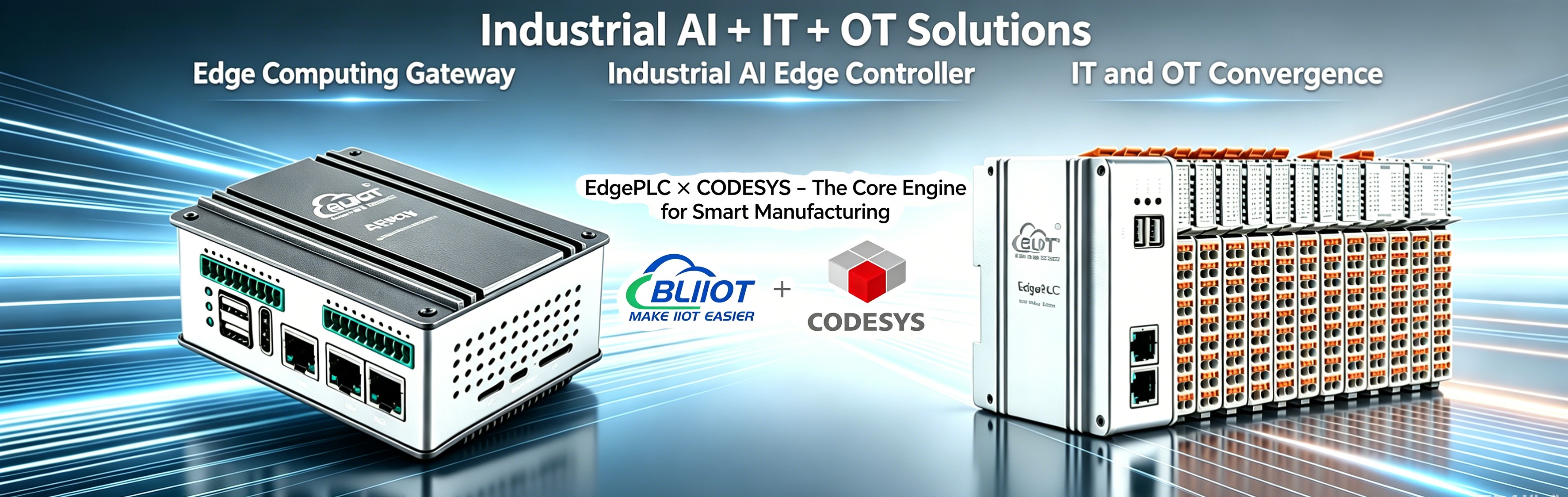
From “Stacked” to “Integrated”: How EdgePLC × CODESYS Breaks the Shackles of Traditional Smart Manufacturing Architectures, enable AI+IT+OT solutions.
Smart manufacturing stands at a critical watershed.
The 2026 Hanover Messe sent a clear signal: AI is moving from “analysis” to “action”, from a decision‑support tool into the factory floor, becoming visible, actionable productivity in handling, assembly, inspection and other processes. Market data confirms the trend – the global industrial automation edge AI market is expected to grow from USD 3.04 billion in 2025 to USD 13.78 billion by 2032, at a CAGR of 24.1%.
Yet behind this wave, a long‑overlooked structural problem is surfacing: a fundamental mismatch between the design thinking of traditional industrial automation architectures and the core requirements of the AI era.
This is not a problem of any single vendor, but a collective dilemma of the entire industrial control system in the age of AI. To understand this dilemma, we must first examine the key bottlenecks of traditional solutions.
I. Deep‑seated pain points of traditional smart manufacturing architectures
1. Deep separation between AI and control
In traditional solutions, AI vision inspection and equipment monitoring often run on industrial PCs (IPCs), while motion control and logic execution are handled by PLCs. They operate independently, creating an awkward “separation of computing and control”. On the surface this division seems reasonable, but it plants fatal hidden dangers for smart manufacturing: when an AI vision model on an IPC detects a product defect, that detection result must be transmitted over a communication bus to the PLC, which then converts it into a control command.
Those few milliseconds – sometimes tens of milliseconds – of delay are enough on a high‑speed line to cause missed captures, positioning errors, or missed defects.
Deeper still, traditional PLC/DCS systems are inherently closed and rigid. Their hardware architecture and software environment are not designed to interface with AI inference. AI models can only “hang” outside the PLC, creating what industry experts call “a clever upper layer but a slow, dumb lower layer”. AI can sense and decide, but cannot directly and reliably drive industrial equipment – a natural “gap” between intelligent decision‑making and real‑time control.
2. Three‑layer stacking: “PLC + IPC + gateway”
On most smart production lines, the control system of one inspection station often consists of three devices: a PLC for real‑time logic and motion synchronisation, an IPC for AI vision and data analysis, and a gateway for protocol conversion and cloud communication.
These three devices come from different vendors, run different operating systems, use different programming environments, and are bridged together through multiple industrial protocols. This means not only high hardware procurement costs, but also complex wiring, serious system integration challenges, and heavy maintenance burdens. As one automation expert bluntly put it: “Traditional PLCs can still handle conventional, low‑compute tasks, but compatibility is poor, and the CPU does not support complex applications.” Another consequence of this stacked architecture is that any system upgrade or fault diagnosis requires dealing with three devices and several communication protocols at the same time. Low O&M efficiency has become an “invisible ceiling” in the digital transformation of manufacturing.
3. IT/OT integration stuck at the “external” level
IT/OT integration is not a new concept, but in traditional solutions it is implemented through “external integration” – the IPC handles IT‑side data processing and cloud connectivity, the PLC focuses on OT‑side logic control, and the two are connected via third‑party software for protocol conversion and data mapping.
At its core, this approach relies on labor‑intensive custom coding to break down data silos. As industry research has revealed, machine data generated by OT systems often have inconsistent formats and are highly vendor‑specific, making them difficult to standardise or reuse across systems. Meanwhile, the OT system’s primary focus is always on ensuring reliable, safe, real‑time control – which makes it inherently inflexible and hardware‑centric. In the early days of Industry 4.0, such custom integration had a market. But with AI now in the picture, this approach can no longer meet the requirements of next‑generation smart manufacturing: millisecond‑level response, closed‑loop control, and native intelligence.
II. EdgePLC × CODESYS: a disruptive technical paradigm
If the pain points above represent the “collective failure” of traditional solutions in the AI era, then the combination of BLIIoT EdgePLC and CODESYS is a systematic answer to those pain points.
1. “Control‑computing convergence”: breaking the natural barrier between AI and control
The core design philosophy of EdgePLC is to give industrial users powerful AI processing capabilities locally, without sacrificing real‑time performance or reliability. Based on an “ARMxy high‑performance processor + distributed I/O expansion” architecture, EdgePLC deeply integrates PLC real‑time control, AI edge inference, and industrial communication capabilities into a single DIN‑rail device.
Take the BL245 series: powered by the Rockchip RK3588J industrial‑grade processor with a heterogeneous computing architecture (4x Cortex‑A76 + 4x Cortex‑A55 + 3x Cortex‑M0), it integrates a dedicated NPU delivering up to 6 TOPS of AI compute, capable of running mainstream deep learning frameworks such as TensorFlow, PyTorch, and Caffe. This means AI inference is performed not in the cloud, not on an attached IPC, but directly inside the EdgePLC’s chip.
More importantly, the AI inference results are passed internally on the chip directly to the CODESYS runtime engine. When the AI vision model detects a defect, the CODESYS logic can immediately execute a rejection action without any intermediate glue code. That is the essence of “control‑computing convergence” – AI and control complete the closed loop on the same hardware platform, in the same memory space, eliminating the delay and gap of “AI recognition → communication → PLC execution” found in traditional solutions.
2. Genuine CODESYS license: an “industrial Android” open ecosystem
If EdgePLC is the hardware carrier, CODESYS is the “soul software” that brings it to life.
CODESYS is the world’s most widely used industrial control programming platform, fully compliant with the IEC 61131‑3 standard and supporting five programming languages: LD, FBD, ST, SFC, and IL. Through hardware independence, multi‑protocol compatibility, and modular design, CODESYS has built an ecosystem similar to “industrial Android”, enabling nearly 400 hardware vendors worldwide to develop control systems on a unified software platform. For engineers accustomed to traditional PLC programming, the learning curve is almost zero – they can seamlessly migrate years of accumulated control logic experience to the EdgePLC platform.
The strategic value of this open ecosystem is that it breaks the “hardware‑software bundling” monopoly of traditional PLC vendors. Users are no longer locked into a single vendor’s proprietary protocols and programming environment; they can freely choose the hardware combination that best fits their needs while enjoying a unified development experience. BLIIoT’s strategic partnership with CODESYS, providing full genuine licenses for the ARMxy series, not only ensures compliance but also removes IP barriers for equipment export.
3. “One device replaces multiple”: redefining integration
The traditional stack of “PLC + IPC + gateway” is compressed into a single EdgePLC device.
One EdgePLC simultaneously plays three roles:
-
Real‑time control layer: built‑in CODESYS, compliant with IEC 61131‑3, achieving millisecond‑level multi‑axis synchronisation via EtherCAT and other buses.
-
Intelligent computing layer: up to 6 TOPS dedicated NPU, performing local edge inference such as AI vision inspection, predictive maintenance, and process optimisation.
-
Data fusion layer: native support for dozens of industrial protocols including MQTT, OPC UA, and Modbus; built‑in Node‑RED visual programming and Docker container deployment environment.
This is essentially native integration of IT, OT, and AI – no external middleware, no cross‑device protocol conversion, no switching between multiple programming environments. Everything is integrated into one device, one platform, one deployment.
III. Old vs. new: evolution from “stitching” to “native”
On real‑time closed‑loop capability, the traditional solution suffers from a natural “AI → communication → PLC” delay chain, while EdgePLC embeds AI inference directly into the control platform, eliminating this bottleneck. This elevates smart manufacturing from “sense‑analyse‑report” to a complete “sense‑decide‑act” closed loop.
On integration complexity, traditional solutions require a system engineering effort across multiple hardware selections, multiple protocol integrations, and multi‑vendor after‑sales coordination. EdgePLC converges all of this into single‑source procurement, single deployment, and unified management – significantly reducing both initial investment and lifecycle O&M costs.
On development and maintenance efficiency, traditional solutions force engineers to master multiple programming languages and tools. CODESYS unifies the programming paradigm, enabling traditional PLC engineers to develop edge AI tasks without relearning, lowering technical barriers and training costs.
On intelligent expansion capability, every new intelligent application in a traditional solution forces re‑evaluation of hardware compatibility. EdgePLC’s containerised environment and open secondary development ecosystem allow new AI models to be deployed as easily as installing an app, leaving ample room for future production line intelligent upgrades.
IV. From “technically feasible” to “indispensable”: deep implications for smart manufacturing
First, it moves smart manufacturing from “technology patchwork” to “architecture native”.
In the past, to implement an AI‑based quality inspection line, a company had to consider four unrelated subsystems: PLC selection, IPC configuration, gateway protocols, and AI model deployment – eventually patching together a barely functional solution. This approach essentially forces together products from different eras; its fragility and maintenance costs only increase over time. The emergence of EdgePLC × CODESYS signals that the core control unit of smart manufacturing is evolving from “discrete patchwork” to “integrated native” – AI is no longer an add‑on, real‑time control is no longer an island, and IT/OT integration no longer requires massive custom integration, but becomes a native capability out of the factory.
Second, it aligns with the historical trend of industrial automation moving from centralised intelligence to edge‑distributed intelligence.
As industry data reveals, AI capabilities are migrating from the cloud to the edge, driven by four forces: bandwidth savings, real‑time response, energy efficiency, and data trust. Especially in latency‑sensitive scenarios such as industrial robotics, the value of edge AI is increasingly evident. EdgePLC is the physical carrier of this trend – it brings true intelligent decision‑making down to the device side, enabling every node on a production line to have independent sensing, decision, and execution capabilities, instead of sending all data back to a central server for processing. This distributed edge‑intelligence architecture is the underlying logic of the smart factory of the future.
Third, it provides both technical and compliance guarantees for Chinese equipment going global.
In a global market where IP protection is increasingly valued, a genuine CODESYS license serves as a “passport” for equipment export. For Chinese manufacturers wanting to export smart equipment to demanding markets such as Europe and North America, the EdgePLC × CODESYS combination offers a reliable path that simultaneously meets technical excellence and legal compliance.
Conclusion
In the second half of smart manufacturing, the competition is no longer about whose PLC is more stable, whose IPC has more compute, or whose gateway supports more protocols – it is about who can truly converge these capabilities into an organic whole where control and computing are one.
Traditional solutions split AI, control, and communication into three separate devices – essentially trying to solve the “integration problem” of the intelligence age with the “division of labour” thinking of the industrial age. That mindset no longer fits the AI era. The strategic combination of BLIIoT EdgePLC and CODESYS is a precise response to this historic shift. It is not an incremental improvement over traditional solutions, but a fundamental paradigm leap: from stacked, piecemeal integration to native, all‑in‑one convergence; from separated execution to closed‑loop intelligence; from code‑based stitching of IT/OT to hardware‑native integration of AI+IT+OT.
When an EdgePLC enters your production line, it brings not just a controller, but the “intelligent brain” of a production line – real‑time control, AI analysis, cloud data uplink, remote O&M – all in one package.
This is the true starting point for smart manufacturing to move from “automation” to “intelligence”.
For more details on EdgePLC products and application cases, please visit the BLIIoT official website or contact our technical support team.


