With the rapid development of Industrial Internet of Things (IIoT) and artificial intelligence technologies, a new generation of AI edge controllers is entering the market at an astonishing pace. Products represented by Beilai Technology's ARMxy BL370 series AI Edge Controllers can achieve complex functions that traditionally required "PLC + industrial computer + gateway" using a single device, redefining the boundaries of industrial control.
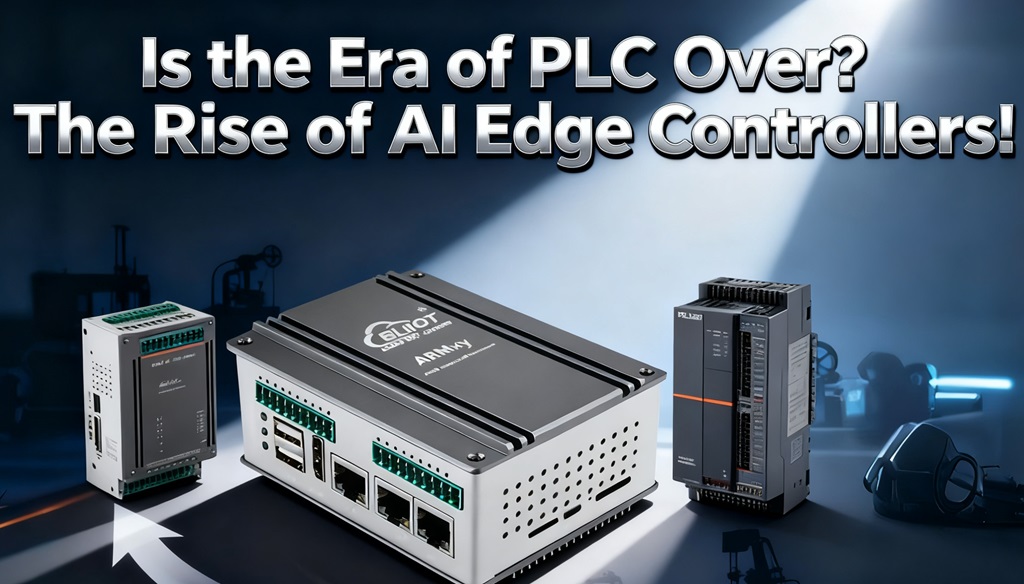
Is the PLC Era Ending? The Rise of AI Edge Controllers!
I. Current Situation: Deep Transformation in Industrial Control Landscape
The industrial automation sector is currently undergoing a significant transformation. Traditional PLCs (Programmable Logic Controllers), after decades of development, have established a complete ecosystem and play a crucial role in global manufacturing. According to statistics, the global PLC market size still exceeded $10 billion in 2023, with small and medium-sized PLCs maintaining steady growth in simple control scenarios.
However, this landscape is being disrupted. With the rapid development of Industrial Internet of Things (IIoT) and artificial intelligence technologies, a new generation of AI edge controllers is entering the market at an astonishing pace. Products represented by Beilai Technology's ARMxy BL370 series AI Edge Controllers can achieve complex functions that traditionally required "PLC + industrial computer + gateway" using a single device, redefining the boundaries of industrial control.
II. Technical Comparison: Significant Generational Differences
-
Hardware Architecture Differences
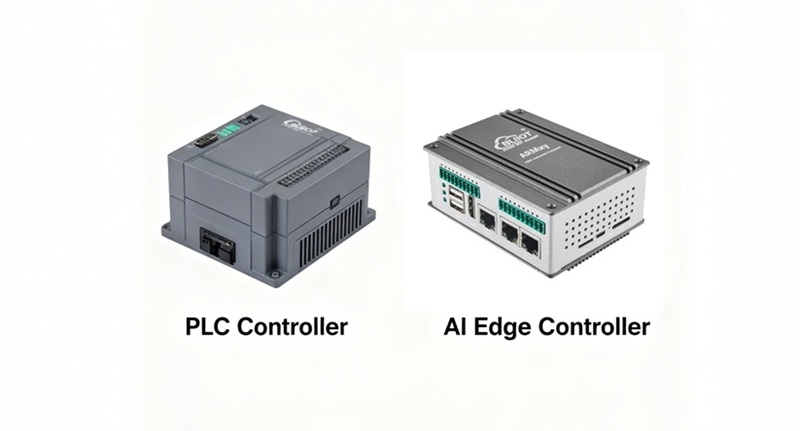
Traditional PLCs adopt dedicated microcontroller architectures, emphasizing stability and reliability. For example, mainstream medium-sized PLCs typically use processors with clock speeds below 800MHz and memory configurations under 512MB, focusing on executing logic control tasks.
AI edge controllers employ new heterogeneous computing architecture. Taking the BL370 as an example:
-
Equipped with RK3562J quad-core Cortex-A53 processor, clocked at 2.0GHz
-
Integrated NPU unit with 1TOPS computing power, supporting deep learning inference
-
Configured with up to 4GB LPDDR4X memory and 32GB eMMC storage
-
Supports rich interface expansion (up to 3 Ethernet ports, 2 USB ports, various I/O modules)
-
Software Ecosystem Comparison
Traditional PLCs use vendor-specific programming environments (such as ladder logic, instruction lists), with relatively closed ecosystems and lower development efficiency. A complex vision inspection project typically requires several weeks of development and debugging.
AI edge controllers are based on an open Linux ecosystem:
-
Supports high-level language development like Python, C++
-
Built-in Docker containers enabling rapid deployment of AI algorithms
-
Provides complete development toolchain (Qt, OpenPLC, Node-RED, etc.)
-
-
Performance Analysis
In terms of control performance, traditional PLCs still maintain advantages, with scan cycles reaching microsecond levels, suitable for safety control scenarios requiring high real-time performance.
However, in intelligent applications, AI edge controllers demonstrate overwhelming advantages:
-
Image processing speed: Traditional solutions require over 200ms, while AI edge controllers can reduce this to under 50ms
-
Data processing capability: A single device can simultaneously handle inference for 256+ AI models
-
Communication efficiency: Supports 10,000+ MQTT connections online simultaneously
III. Application Benefits: Key Support for Digital Transformation
-
Cost Optimization
Traditional solutions require multiple devices working together (PLC + industrial computer + gateway), with total costs ranging from $2,000-5,000. AI edge controllers can achieve the same functionality with a single device, reducing hardware costs by over 40% and maintenance costs by 60%.
-
Efficiency Improvement
An automotive components manufacturer using BL370 achieved:
-
Product inspection efficiency increased by 3 times (2000 pieces/hour → 6000 pieces/hour)
-
Equipment failure prediction accuracy reached 95%
-
Maintenance personnel reduced by 50%, achieving "unmanned" inspections
-
Flexible Manufacturing
The modular design of AI edge controllers (X/Y series I/O boards) supports rapid production line reconfiguration, reducing changeover time from 2 hours to 15 minutes, better adapting to multi-variety, small-batch production needs.
IV. Future Trends: Intelligent and Integrated Innovative Development
-
Accelerating Technology Integration
It is estimated that by 2026, over 60% of new production lines will use AI edge controllers as core control devices. Traditional PLCs will gradually retreat to specific areas such as safety control.
-
Platform Development
AI edge controllers are evolving toward an "Industrial Android" direction:
-
Open source ecosystem increasingly quickly
-
Application store models gradually maturing
-
Barriers to secondary development continuously lowering
-
Cloud-Edge-Device Collaboration
New infrastructure comprising 5G + AI edge controllers will enable:
-
Millisecond-level cloud control response
-
Distributed intelligent decision-making systems
-
Unified management of global devices
-
Changing Talent Demand
Future industrial sites will require not just electrical engineers, but interdisciplinary talent with expertise in AI algorithms, cloud computing, and automation. It is estimated that the talent gap in related fields will reach millions in the next five years.
V. Implementation Suggestions: Steadily Advancing Intelligent Upgrade
For manufacturing enterprises, we recommend:
-
Prioritize AI edge controller architecture for new projects
-
Implement intelligent transformation of existing production lines in phases
-
Focus on cultivating "AI + industrial" interdisciplinary talent
-
Choose products with good openness and ecosystems
Although PLCs will continue to exist in specific fields for a long time, the rise of AI edge controllers is irreversible. This technological transformation is not just about equipment upgrades but represents a key opportunity for the digital transformation of the entire manufacturing industry. Enterprises that plan early and practice early will gain a leading position in future smart manufacturing maturity competition.
(This article is based on the analysis of Beilai Technology's ARMxy BL370 series AI Edge Controllers specifications and industry application practices)


