Top 10 most-used Node-RED nodes in Industrial IoT by BLIIoT, plus BL118 edge gateway with pre-installed Node-RED for fast data collection, protocol conversion, and cloud access.
In the world of industrial automation, Node-RED is like a “universal LEGO board” – drag and drop, and you can piece together data, protocols, and logic with ease.
But did you know? Even though Node-RED has thousands of nodes, industrial users tend to stick to just a few “permanent cast members.”
Today, BLIIoT is here to list the Top 10 most commonly used Node-RED nodes in the field of Industrial IoT and automation. Let’s see how many you’ve tried!
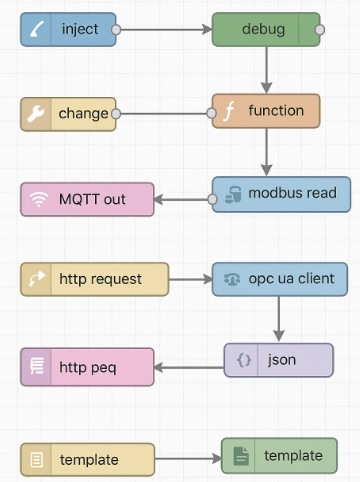
TOP 1 – inject (Manual/Timed Trigger)
An essential for industrial debugging. Like the “start button” in a PLC, it can manually send data with a click or trigger in timed loops. When debugging Modbus or MQTT flows, it’s your trusty companion.
TOP 2 – debug (Debug Window)
Without this, it’s like working blindfolded. It shows the status of all data flows in the right-hand panel. Use it more during debugging, but keep it minimal in production to avoid overwhelming information.
TOP 3 – function (JavaScript Processing)
Need to calculate, judge, or format data? The function node is your “data processing plant.” Perfect for complex logic, with maximum flexibility.
TOP 4 – change (Quick Field Modifier)
Don’t want to write code? The change node lets you directly modify msg.payload, msg.topic, or add/remove fields. It’s the no-code alternative to the function node.
TOP 5 – MQTT in/out (Publish & Subscribe)
A top choice for industrial cloud connectivity. Whether uploading PLC data to the cloud or receiving cloud-issued control commands, the MQTT nodes are your bridge.
TOP 6 – modbus read/write (Modbus Read/Write)
The “veteran big brother” of industrial protocols. Reading temperature/humidity, collecting meter data, controlling relays – all rely on this. Supports both Modbus RTU and Modbus TCP.
TOP 7 – opc ua client (OPC UA Client)
The “diplomat” of Industrial IoT. When working with PLCs, robots, and acquisition devices from different brands, the OPC UA node lets you communicate seamlessly across manufacturers.
TOP 8 – http request (HTTP Request)
A must-have for connecting to web APIs, enterprise databases, or cloud platforms. Handles both GET and POST professionally. Often paired with the function node for data packaging.
TOP 9 – json (JSON Converter)
Most industrial cloud platforms use JSON format. This node switches between strings and JSON objects freely – a great partner for MQTT, HTTP, and OPC UA.
TOP 10 – template (Template Output)
Need to generate formatted strings, HTML reports, or alarm messages? The template node lets you create them like writing a Word document template.
Summary
While Node-RED offers countless nodes, in Industrial IoT and automation, these ten cover almost 80% of real-world needs.
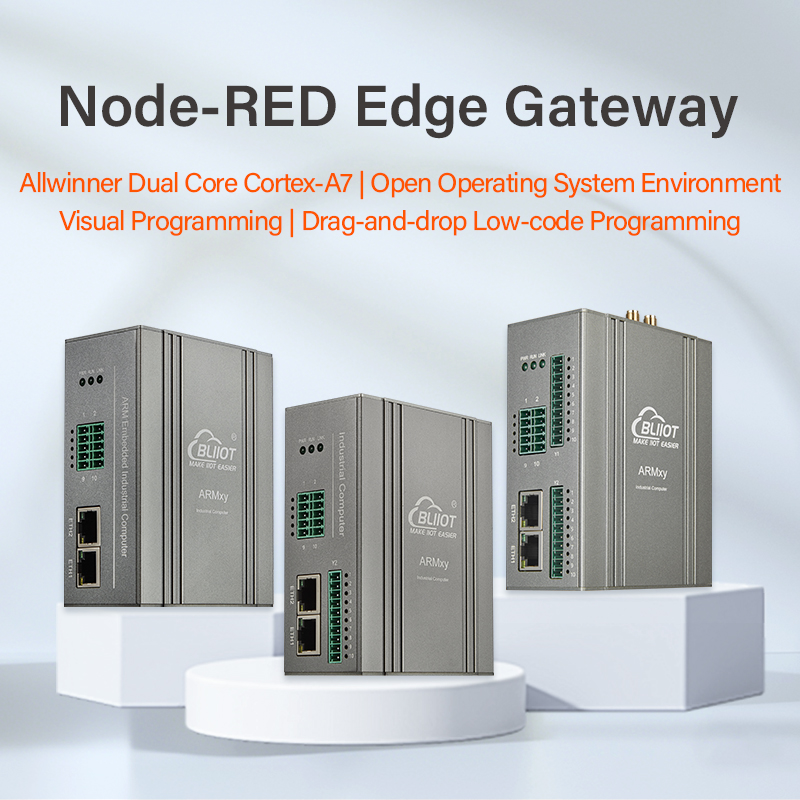
Even better – BLIIoT’s ARMxy series industrial controllers come with Node-RED pre-installed. Power on and start using these nodes right away, without the hassle of setup – enabling data acquisition, protocol conversion, and cloud integration in one step.
Industrial users choose Node-RED because it’s stable, fast, and worry-free.
Product Recommendation – BL118 Node-RED Edge Computing Gateway
If you’ve been impressed by Node-RED’s drag-and-drop magic, then the industrial-grade BL118 is your must-have “IoT Transformer.”
It’s not just a “gateway with Node-RED” – it’s much more:
🔧 Industrial-Grade Hardware – Allwinner T113-i dual-core A7 processor, -45~80℃ wide temperature operation, anti-interference, anti-disconnection, rugged aluminum casing.
🔌 Modular Design – Flexible choice of X boards (serial & I/O) and Y boards (multi-function I/O), like building blocks to connect all your on-site sensors and devices.
🛰 Remote O&M Tool – Built-in BLRAT remote management tool for debugging, configuration, and upgrades – allowing engineers to “control the worksite” from the office.
🌐 Protocol Powerhouse – Supports Modbus, OPC UA, MQTT, BACnet, HTTP, WebSocket, and connects to Alibaba Cloud, Tencent Cloud, Huawei Cloud, AWS, and more with a single click.
Conclusion:
“It’s not just a gateway – it’s a Node-RED battle fortress for industrial control engineers.”
Node-RED isn’t just a tool – it’s a magnifying glass for your logical thinking. With a few drags and clicks, industrial automation becomes reality.


