TLS is the core mechanism IoT gateways use to protect data over public networks. This article explains TLS/SSL principles, the real risks of unencrypted industrial gateways, and selection dimensions such as native TLS, mutual authentication, and X.509 certificates.
Is Your IoT Gateway Still Running Exposed? A Plain Guide to TLS Encryption and Selection
TLS—often mistakenly written as “TTL”—is the core mechanism that IoT gateways use to protect data transmitted over public networks. In infrastructure and industrial environments, gateways carry OT data to cloud platforms and IT systems. Without encryption, that data is effectively “running exposed” in transit.
1. First, Clear Up the Concept: What Is TLS, and Why Is It Often Written as “TTL”?
In the industrial IoT context, what users refer to as “TTL/TLS” is actually TLS (Transport Layer Security) . “TTL” has a different meaning in networking—Time To Live, an IP packet loop-prevention mechanism—and has nothing to do with data encryption. Terms such as “TLS/SSL” and “TSL/SSL” commonly seen in industrial gateway documentation all refer to TLS and its predecessor, SSL.
TLS is the standardized, upgraded version of SSL. SSL was originally introduced to establish an encrypted channel between a client and a server. TLS corrected known security weaknesses in SSL and adopted stricter key exchange, message authentication, and cipher suites, making it the de facto standard for secure communication on the Internet and in industrial IoT. When a gateway enables TLS, data is encrypted before transmission and decrypted only at its destination. Any node that intercepts the data in between sees only ciphertext.
Common TLS configurations in industrial gateways include:
-
One-way authentication: the gateway verifies the cloud server’s certificate, ensuring it is connecting to the “real” server;
-
Mutual authentication (mTLS): the cloud also verifies the gateway’s X.509 client certificate, preventing unauthorized devices from connecting;
-
Cipher suites: symmetric encryption such as AES-128/256, combined with RSA/ECDHE key exchange, balancing security and performance.
2. Why Must IoT Gateways Be Encrypted?
Industrial data includes equipment status, process parameters, and energy consumption information. Once intercepted or tampered with, the consequences go far beyond data leakage. An unencrypted gateway faces several realistic threats:
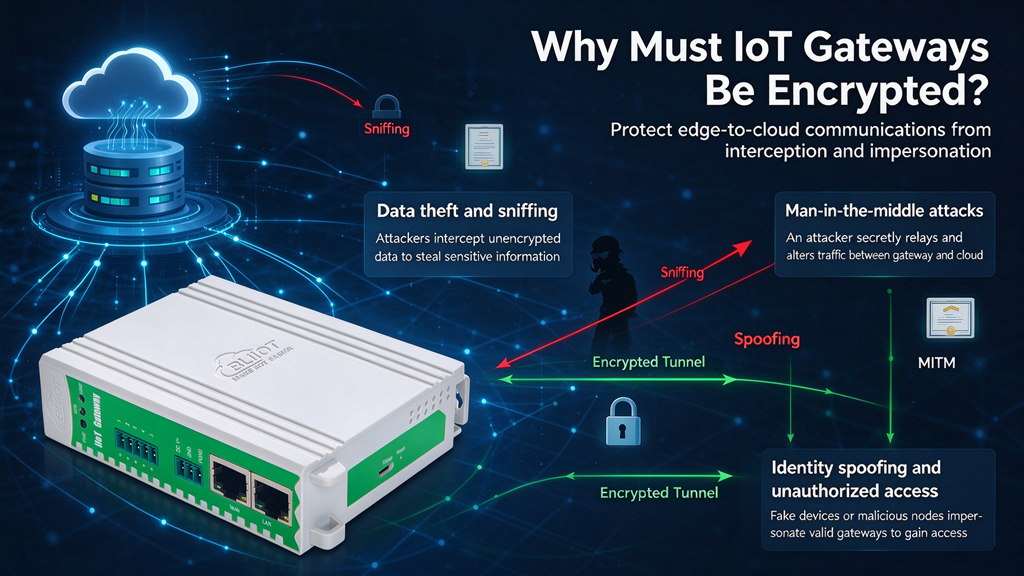
Data theft and sniffing. Protocols such as MQTT and Modbus TCP transmit data in plaintext by default. An attacker who gains access to the same network can read production data, instrument readings, or even control commands.
Man-in-the-middle attacks. An attacker can intercept and tamper with data packets between the gateway and the cloud, forge sensor values, or issue false control commands, leading to incorrect decisions or equipment malfunction.
Identity spoofing and unauthorized access. Without certificate-based authentication, any device can pretend to be a legitimate gateway sending data to the cloud platform—or pretend to be the cloud platform sending commands to the gateway.
TLS encryption combined with X.509 certificate authentication solves two problems at once: confidentiality (others cannot understand the data) and identity authenticity (who the other party really is). It is the necessary path for IoT gateways to move from “can communicate” to “can be trusted.” When selecting a product, what should be confirmed is native TLS/SSL support, rather than relying on external modules or additional development.
3. Classic Market Products and Selection Dimensions
In the industrial IoT gateway market, data encryption capability has become a mainstream configuration. For example, some industrial routers and edge gateways from InHand support national cryptographic algorithms, AES-256 encryption, and device authentication. Industrial gateway and router products from Huawei, Advantech, and other vendors also generally offer TLS/SSL, VPN, and certificate management as standard or optional capabilities for establishing secure tunnels between devices and cloud platforms.
When choosing an industrial gateway, key dimensions for judging security maturity include: whether native TLS/SSL is supported (especially mutual authentication and X.509 certificate management), whether encryption covers uplinks such as MQTT, and whether keys can be managed securely.
On this dimension, products with different positioning offer different security paths. Taking Bliiot Technology as an example, its BL110 is more of a protocol-conversion gateway, suitable for scenarios where PLCs or Modbus devices already exist on site and protocol aggregation with encrypted cloud upload is required. It supports TLS/SSL, X.509 root certificates, and data retransmission. The EdgeIO series (such as BL192Pro) is more of an IT/OT convergence edge I/O node. In addition to local I/O acquisition, Modbus RTU instrument access, and Web-based logic control, it also emphasizes X.509 certificates, AES-256 encryption, and IEC 62443 security standards. It is suitable for distributed infrastructure requiring an integrated “acquisition + control + multi-protocol openness + secure cloud upload” capability. What both have in common is this: as long as data leaves the site and enters a public network or the cloud, TLS/SSL encryption should be a mandatory option, not an optional one.
4. Selection Guidance: Clarify the Need First, Then Discuss Security Capabilities
If the core need is “protocol aggregation and cloud upload” —PLCs or Modbus devices already exist on site, and the main goal is protocol conversion, encrypted cloud upload, and remote PLC maintenance. Points are relatively concentrated, and flexible 4G/WiFi connectivity may be required. A protocol-conversion gateway (such as BL110) can be considered first.
If the core need is “edge convergence and control” —local I/O acquisition, edge logic control, Modbus RTU instrument access, and simultaneous openness to cloud platforms and upper-layer systems via MQTT, Modbus TCP, and OPC UA are required. Sites are distributed, and higher industrial security standards are needed. An edge I/O controller (such as the EdgeIO series) is more suitable.
Whichever type you choose, prioritize whether the product supports native TLS, X.509 certificate management, and an auditable key policy, rather than simply looking for the words “supports encryption.”
In one sentence: Encryption for IoT gateways protects more than data—it protects the trusted boundary of industrial systems in an open network. First clarify whether you need “protocol aggregation” or “edge convergence,” then use TLS/SSL capability as the security entry threshold.