An Industrial IoT Gateway is a hardware device deployed on the industrial site, close to the data source. It is responsible for connecting various industrial equipment, sensors, controllers (such as PLCs), and more to the cloud or local servers. It possesses core capabilities such as data acquisition, protocol conversion, edge computing, and secure transmission, making it a crucial hub that bridges the gap between devices and higher-level systems in an Industrial Internet of Things (IIoT) .
Industrial IoT Gateway: The Intelligent Hub for Connectivity, Computing, and Industrial Transformation
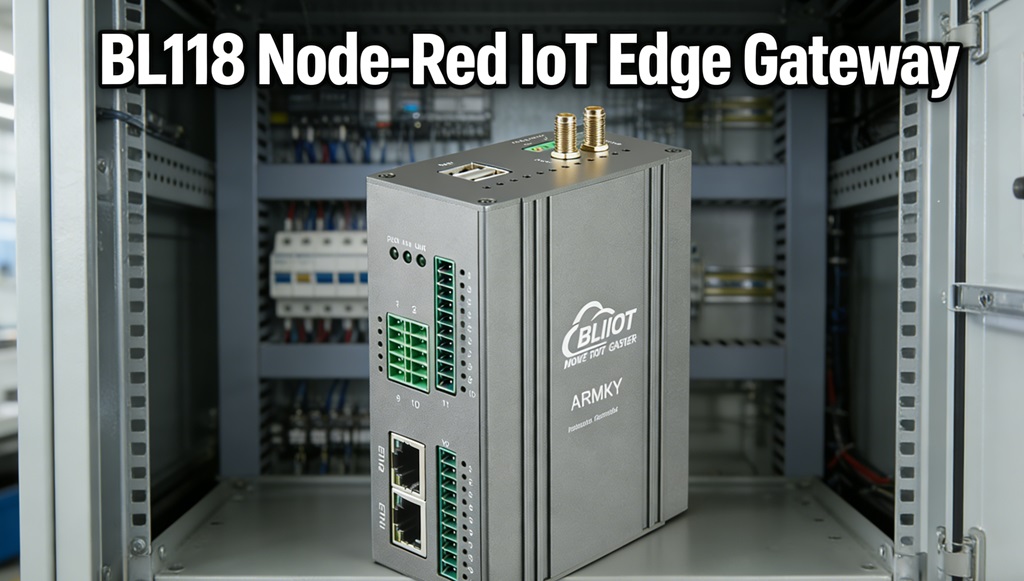
In the wave of Industry 4.0 and digital transformation, a key technological component is increasingly becoming the core of smart factories, smart energy, and similar scenarios—the Industrial IoT Gateway. It is not only a "translator" and "connector" between devices and networks but also a "smart node" that enables data aggregation, edge computing, and intelligent decision-making. This article uses the BL118 series Node-RED edge computing gateway as an example to explain the core value and functions of an industrial IoT gateway.
1. What is an Industrial IoT Gateway?
An Industrial IoT Gateway is a hardware device deployed on the industrial site, close to the data source. It is responsible for connecting various industrial equipment, sensors, controllers (such as PLCs), and more to the cloud or local servers. It possesses core capabilities such as data acquisition, protocol conversion, edge computing, and secure transmission, making it a crucial hub that bridges the gap between devices and higher-level systems in an Industrial Internet of Things (IIoT) architecture.
2. Core Functions of an Industrial IoT Gateway
-
Multi-Protocol Access and Data Acquisition
Industrial sites host a wide variety of devices from different brands using diverse protocols (e.g., Modbus, Siemens S7, CAN, BACnet). The IoT gateway comes with a rich library of built-in drivers, allowing it to connect to devices using different protocols simultaneously and achieve unified data collection.
-
Protocol Conversion and Standardization
The gateway converts collected data into a unified protocol suitable for cloud transmission (e.g., MQTT, HTTP, OPC UA), solving the problem of "information silos" and enabling system interoperability.
-
Edge Computing and Real-Time Processing
It performs preliminary processing, filtering, aggregation, and even logical judgment at the source of data generation. This reduces the burden on the cloud and improves response speed. For example, the BL118 comes pre-installed with Node-RED, supporting visual drag-and-drop programming to implement local logic control and data processing.
-
Secure and Reliable Data Transmission
It supports both wired (Gigabit/Fast Ethernet) and wireless (4G/5G/Wi-Fi) networks. Features like transmission resumption and encrypted data transfer ensure stable data upload to the cloud, even in harsh industrial environments.
-
Industrial-Grade Reliability Design
Designed to withstand wide temperature ranges (-40°C to 85°C), electromagnetic interference (EMC/EMI), with isolation protection and a hardware watchdog timer, it adapts to challenging environments involving vibration, humidity, heat, and interference.
3. Why is an Industrial IoT Gateway Needed?
-
Solves Device Heterogeneity: Acts as a "protocol translator" for legacy equipment that cannot communicate directly with modern systems.
-
Reduces Network Load and Cost: Edge computing minimizes the upload of raw data, saving bandwidth and cloud storage costs.
-
Improves System Responsiveness: Local processing enables millisecond-level control, suitable for real-time monitoring and alerts.
-
Enhances Data Security: Data can be pre-processed locally, and sensitive information can be kept on-site, complying with industrial security standards.
-
Supports Flexible Deployment and Expansion: Modular design (like the X/Y board expansion of the BL118) allows flexible configuration of I/O and functions based on specific needs.
4. Typical Application Scenarios
-
Smart Factories: Connects PLCs, robots, and sensors to enable equipment status monitoring, energy efficiency management, and predictive maintenance.
-
Smart Energy: Connects to electricity meters, water meters, temperature, and humidity sensors for energy consumption data collection and remote management.
-
Smart Cities: Used for networking and maintenance of distributed devices like street light control, environmental monitoring, and traffic signals.
-
Rail Transit and Building Automation: Integrates various subsystems for centralized monitoring and intelligent联动.
5. The BL118 Series: A Typical Example of an Industrial IoT Gateway
The BL118 series embodies the development direction of modern industrial IoT gateways with the following outstanding features:
-
High Performance and Openness: Equipped with a dual-core A7 processor, pre-installed with Ubuntu and Node-RED, supporting user secondary development.
-
Rich Interfaces and Modular Expansion: Supports various I/Os like RS485/CAN/DI/AI, with optional Wi-Fi/4G/5G communication modules.
-
Visual Low-Code Development: Built-in Node-RED allows workflow orchestration and logic design without requiring extensive programming knowledge.
-
Industrial-Grade Robust Design: Passes rigorous tests for EMC, high/low temperature, and vibration, suitable for various industrial environments.
-
Cloud-Edge-Device Collaboration: Supports integration with multiple cloud platforms like MQTT, OPC UA, Huawei Cloud, and Alibaba Cloud for seamless data upload.
Conclusion
The industrial IoT gateway is not merely a "connector" for the industrial internet but also a carrier of "intelligent edge" capabilities. By integrating heterogeneous devices, enabling local data processing, and ensuring secure transmission, it provides industrial enterprises with a low-cost, efficient, and highly reliable path for digital transformation. As edge computing and AI technologies continue to converge, future industrial IoT gateways will become more intelligent and autonomous, serving as indispensable infrastructure in the ongoing journey of industrial intelligence.


