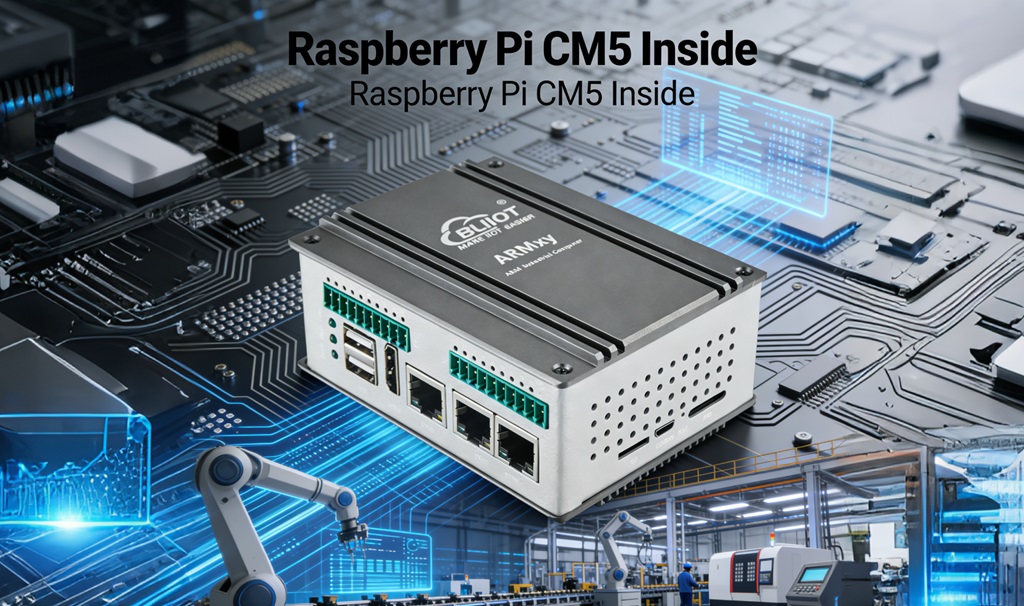
Edge computing controllers developed based on the Raspberry Pi CM5 are becoming critical hardware platforms enabling intelligent, real-time, and flexible transformations across various fields including industry, energy, and transportation.
Typical Application Scenarios of Raspberry Pi CM5 Edge Computing Controllers
The Raspberry Pi CM5 (Compute Module 5), as a new generation of high-performance embedded core modules, features a quad-core ARM Cortex-A76 processor and a VideoCore VII GPU. It combines three key advantages: strong computing power, low power consumption, and an open ecosystem. Edge computing controllers developed based on the CM5 (such as the BL460 series) are becoming critical hardware platforms enabling intelligent, real-time, and flexible transformations across various fields including industry, energy, and transportation. The following is an analysis of their typical application scenarios:
Industrial Automation and Smart Manufacturing
1. Intelligent Visual Inspection Systems
Leveraging the CM5's 4K image processing capability and GPU acceleration, tasks such as product surface defect detection, character recognition, and dimensional measurement can be performed in real-time at the production line edge. This replaces traditional Industrial PC + vision software solutions, reducing system costs and response latency.
2. Flexible Robotic Control
Combined with an EtherCAT master station and a real-time Linux kernel, it enables trajectory planning and synchronized control for multi-axis robots and collaborative arms. It supports protocols like Modbus/TCP and OPC UA for integration with MES/SCADA systems, adapting to small-batch, multi-variety production models.
3. Production Line Data Acquisition and Monitoring
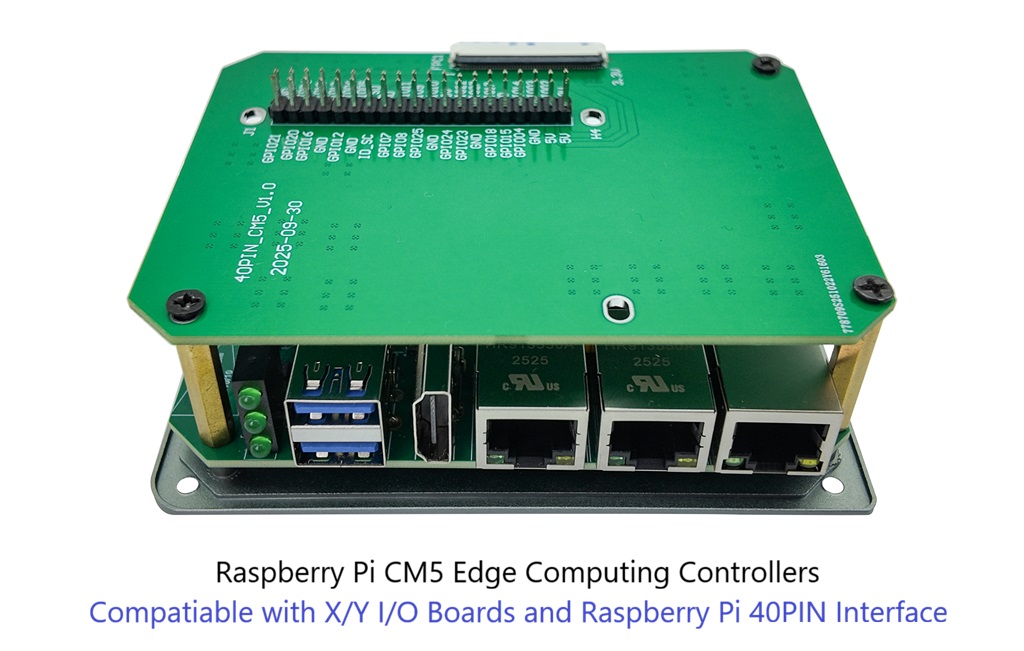
By connecting various sensors and actuators through expansion I/O modules (DI/DO/AI/AO), it collects data such as vibration, temperature, and current in real-time. Local anomaly diagnosis and early warning are performed, and data can be synchronized to cloud platforms via MQTT/HTTP.
Energy Management and Green Systems
1. Energy Storage Systems (EMS/BMS)
Serving as the edge controller for energy storage power stations, it enables real-time acquisition of battery pack voltage, current, temperature data, and balanced control. It supports PCS (Power Conversion System) scheduling and grid-connected/islanding switch logic, with built-in algorithms for SOC estimation and lifespan prediction.
2. Photovoltaic Power Station Monitoring
Integrated with RS485/Ethernet communication, it connects to inverters, electric meters, weather stations, etc., enabling power generation efficiency analysis, fault location, and intelligent cleaning control. It supports power protocols like IEC104 and DNP3 to meet grid dispatch requirements.
3. Electric Vehicle Charging Piles
Supports OCPP protocol and integration with payment systems for charging process control, billing management, and safety protection. It enables remote firmware upgrades via 4G/5G connectivity and can feature LCD display or voice interaction interfaces.
Transportation and Infrastructure
1. Intelligent Rail Vehicle Onboard Equipment
Used for train condition monitoring (e.g., bearing temperature, vibration acquisition), passenger information display, video surveillance storage, and edge analysis. Complies with rail transit standards like EN50155 and withstands harsh environments involving vibration and wide temperature ranges.
2. Roadside Edge Computing Units
Deployed in smart streetlights, traffic signals, and video surveillance poles, they enable functions like license plate recognition, pedestrian flow statistics, and environmental monitoring. This reduces the bandwidth pressure of video stream backhaul and improves the response speed of traffic management systems.
3. Charging Station Cluster Management
Acts as an edge gateway for charging stations, managing multiple charging piles uniformly to achieve load balancing and orderly charging, while interacting with the power grid for demand response.
Medical and Specialized Equipment
1. Medical Testing Instruments
Serves as the main control unit in devices like blood analyzers and biochemical analyzers, performing motion control, temperature control, optical detection, and preliminary data analysis. It enables sample traceability via barcode/RFID.
2. Environmental Monitoring Terminals
Connects various gas, water quality, and noise sensors for local data aggregation and exceedance alarms. Supports offline data buffering and remote configuration, applied in smart cities, industrial parks, and similar scenarios.
IoT and Protocol Convergence Gateways
1. Multi-protocol Industrial Gateways
Using software like BLIoTLink, it converts heterogeneous protocols (Modbus RTU/TCP, CAN, BACnet, PROFINET, etc.) into unified MQTT/OPC UA data models for upload to platforms like AWS IoT, Azure IoT, and Ignition.
2. Edge Video Analytics Nodes
Based on frameworks like YOLO and OpenCV, it performs real-time recognition of events such as faces, vehicles, and safety helmet usage in surveillance video streams, triggering local alerts or image capture uploads.
3. Distributed Device Operation & Maintenance Portal
Equipped with the Node-RED visual tool, it enables rapid setup of device status dashboards and fault log dashboards. Combined with BLRAT, it facilitates remote SSH, file transfer, and batch firmware upgrades.
Agriculture and Special Environments
1. Intelligent Greenhouse Controllers
Based on data from temperature/humidity, light, and CO₂ sensors, it automatically controls fans, shade nets, and irrigation valves. Supports LoRa/WiFi connections to wireless sensor networks.
2. Aquaculture Monitoring
Real-time acquisition of water parameters like pH, dissolved oxygen, and temperature, controlling aerators and feeders. Uses models to predict water quality trends.
Summary: Core Advantages of CM5 Edge Controllers
The Raspberry Pi CM5 edge computing controller, with its balance of performance, openness, and reliability, has become one of the preferred platforms for intelligent transformation across multiple industries. It not only lowers the barriers to system integration and development but also, through its new architecture of "edge sensing, local decision-making, and cloud collaboration," drives various sectors toward a more efficient, flexible, and intelligent future.
This article is compiled based on relevant product materials from Shenzhen Beilai Technology Co., Ltd. and the technical characteristics of the Raspberry Pi CM5, aiming to demonstrate the practical value of edge computing controllers in typical application scenarios.


